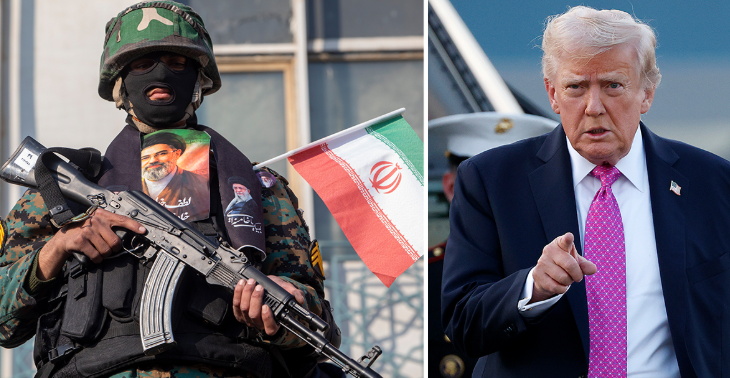
Donald Trump has described Iran’s ten‑point proposal as a “workable basis on which to negotiate.” But as details of the plan began to emerge, several experts reacted with shock and disbelief.
“It looks like Trump has capitulated massively,” said Sky News U.S. correspondent Mark Stone.
Just an hour before Trump’s deadline Tuesday began with Donald Trump warning that a “whole civilization” of 90 million Iranians could face annihilation.
But shortly before Trump’s deadline to escalate military action expired, the United States and Iran agreed to a temporary two‑week ceasefire.
According to Axios reporter Barak Ravid, a longtime authority on international conflicts, Pakistan played a key role in the negotiations. Behind the scenes, Egypt helped bring the U.S. and Iran closer together, and Turkey also assisted in facilitating talks, he said in a tweet.
Meanwhile, The New York Times, citing three Iranian sources, reports that China stepped in at the last minute. According to the paper, Beijing urged Tehran to “show flexibility and reduce tensions,” pointing to the global economic fallout from the conflict. The White House says Israel also agreed to the pause. Announcing the decision to halt further strikes, Trump said Iran had presented a ten‑point proposal, calling it a “workable basis on which to negotiate.”
The ceasefire marks a fragile diplomatic breakthrough after days of missile and drone attacks across the Middle East. Talks are expected to continue in Islamabad, following mediation efforts by Pakistani Prime Minister Shehbaz Sharif.
What’s in Iran’s proposal? According to Iranian state media, Tehran has stated it will only agree to end the war once the details are finalized in accordance with a ten‑point peace plan allegedly sent to Washington through Pakistani intermediaries. The list includes several conditions the United States has historically opposed.
While full details have not been officially confirmed, Iranian state media claims the plan includes sweeping demands such as:
- A non‑aggression pact between the U.S. and Iran
- Continuation of Iran’s control over the Strait of Hormuz
- Recognition of Iran’s nuclear enrichment rights
- Lifting of all primary U.S. sanctions
- Lifting of all secondary sanctions affecting third‑party countries
- Termination of all UN Security Council resolutions against Iran
- Termination of all International Atomic Energy Agency (IAEA) Board resolutions
- Payment of compensation to Iran for damages
- Withdrawal of U.S. combat forces from the region
- Cessation of war across all fronts, including conflicts involving Iran‑backed groups such as Hezbollah in Lebanon
Ceasefire linked to Hormuz reopening At the center of the agreement is the Strait of Hormuz — one of the world’s most critical oil routes. Iran has agreed to allow controlled traffic through the strait for two weeks, a crucial step given that roughly 20% of the world’s oil supply passes through it. In return, the U.S. has paused offensive operations, including plans to expand strikes on Iranian infrastructure.
Following the announcement, the White House described the two‑week ceasefire as a major win for Washington.
Press Secretary Karoline Leavitt said Operation Epic Fury had achieved its goals in just 38 days — weeks ahead of schedule. “This is a victory for the United States that President Trump and our incredible military made happen,” Leavitt said in a statement.
She added, “From the very beginning of Operation Epic Fury, President Trump estimated this would be a 4–6 week operation. Thanks to the unbelievable capabilities of our warriors, we have achieved and exceeded our core military objectives in 38 days.”
“A complete victory” The announcement of a two‑week pause has been described by U.S. correspondent Mark Stone as appearing to represent a significant capitulation by Donald Trump.
According to Stone, Trump has effectively “kicked an almighty can down the road,” giving the Iranian regime the upper hand. Stone spoke briefly with Trump by phone overnight following the ceasefire announcement.
Trump reportedly told him, “I haven’t got long, be quick,” before adding that he felt the situation was “great… very good.”
He went on to describe the military operations as a complete success, calling it “a complete victory, a victory in military terms.” Trump further asserted that, in every other sense as well, it amounted to “a complete victory.”
“The level of incompetence is stunning” Not everyone views the temporary ceasefire as a win for the White House. Tuesday’s agreement was shaped by the highly charged and polarized emotions that Trump consistently inspires.
Some critics even mocked it as another “TACO” moment — “Trump Always Chickens Out.”
Democratic lawmakers responded with a mix of relief and criticism.
“Stopping war is good,” Senator Ruben Gallego wrote on X. “I am glad our men and women in uniform will be out of danger. We can criticize why we got into this war, the illegality of it and holding the Trump admin accountable. But right now I am relieved.”
Senator Chris Murphy called Iran’s control of the Strait of Hormuz a “history‑changing win” for Tehran. “The level of incompetence is both stunning and heartbreaking,” he said on X.
Senator Ed Markey added, “I’m glad there is a reported ceasefire deal with Iran. But we shouldn’t be in this illegal war in the first place. And Donald Trump can’t simply threaten war crimes with impunity. Congress needs to get back in session now to stop this war and remove Donald Trump.”
What happens next? Will the parties reach a lasting peace, or is this simply a temporary pause in the conflict?