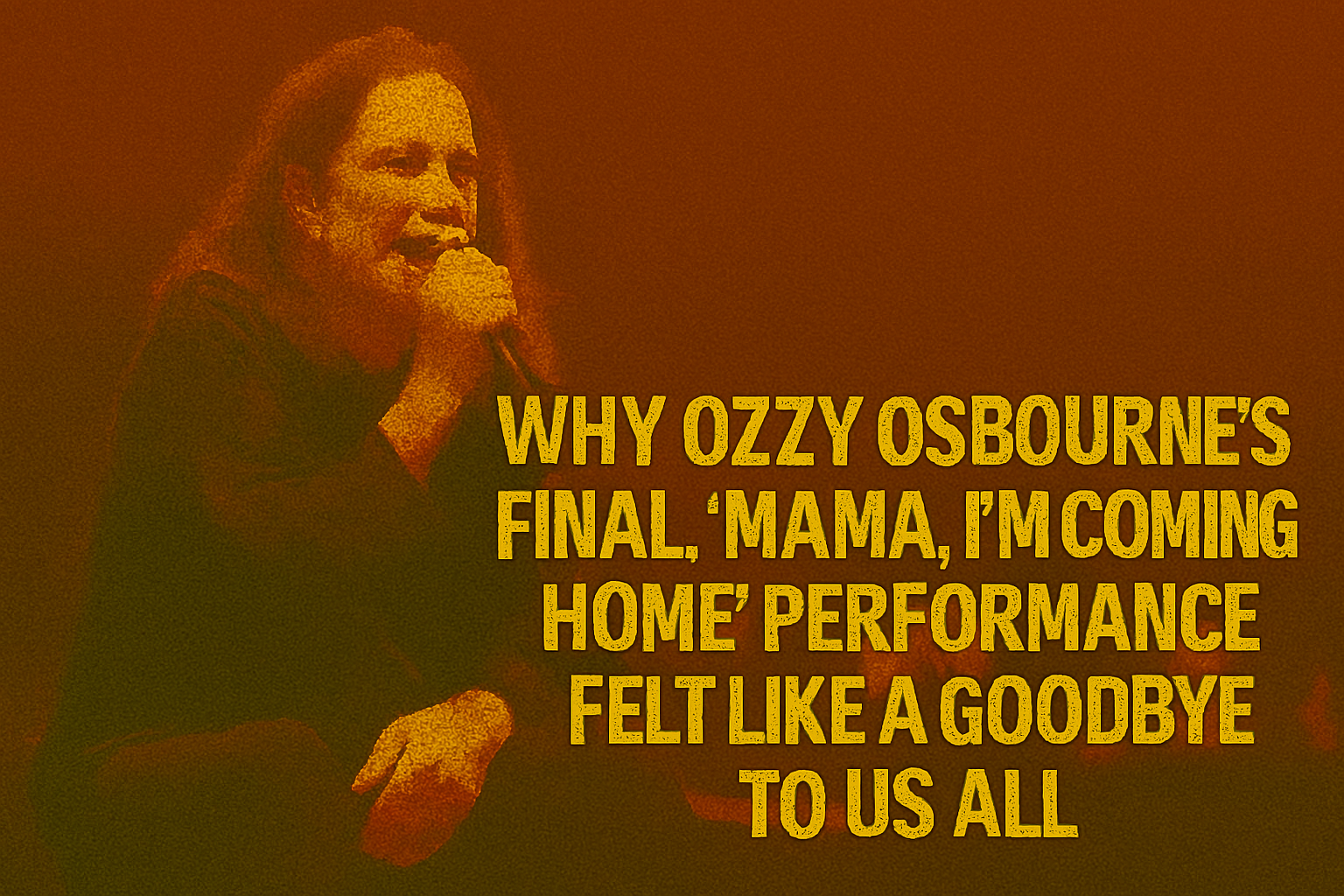
Ozzy Osbourne’s last live rendition of “Mama, I’m Coming Home” carried the weight of a lifetime into a single, fragile moment. What began as a simple power ballad became, in that performance, a communal farewell: a song that had comforted listeners for decades transformed into a shared act of remembrance. The performance felt intimate and public at once, a private confession delivered on a stage that held thousands.
The Song as a Vessel for Memory
“Mama, I’m Coming Home” has always been a song about return and reconciliation. Its spare arrangement and direct lyricism leave room for emotion to breathe, and Ozzy’s voice—worn but unmistakable—has always been the conduit. In his final performance, those elements aligned in a way that made the song function less as entertainment and more as a ritual. Every line read like a signpost through a life: regret, longing, the desire to make amends. For fans who had followed him through decades of excess, reinvention, and survival, the song became a way to place the arc of his career into human terms.
The Atmosphere of the Night
The setting amplified the song’s gravity. The lights softened, the crowd hushed, and the usual distance between performer and audience narrowed. In that hush, small details mattered: the way Ozzy inhaled before a phrase, the tremor in a held note, the way he looked out at the audience as if searching for faces he knew. Those moments made the performance feel less like a polished show and more like a conversation. When the chorus arrived, it wasn’t just Ozzy singing; it was thousands of voices answering back, turning a personal confession into a communal benediction.
A Lifetime Compressed into Minutes
Part of why the performance landed so hard is that it condensed a long, complicated life into a few minutes of music. Ozzy’s public story—his rise with Black Sabbath, his solo success, his battles with addiction and health, his reinventions—has always been dramatic. But in the quiet of “Mama, I’m Coming Home,” those headlines and tabloid moments fell away. What remained was the human core: a man who had loved, lost, erred, and endured. The song’s simple refrain became a way to acknowledge that complexity without needing to narrate it.
The Audience as Witness
A performance becomes a goodbye when the audience recognizes it as such. In that moment, fans were not passive consumers but active witnesses. People who had grown up with the song brought their own histories to the stadium—first loves, hospital rooms, late-night drives, moments of grief and healing. When they sang along, they were not only honoring Ozzy; they were also honoring what the song had meant to them. That reciprocity—artist and audience holding the same fragile thing—made the farewell feel mutual rather than one-sided.
The Emotional Currency of Familiarity
Familiarity is a powerful emotional currency. A song that has been present at many points in people’s lives accrues meaning beyond its original intent. “Mama, I’m Coming Home” had been a soundtrack for weddings, funerals, and quiet personal reckonings. In Ozzy’s final performance, that accumulated meaning surfaced all at once. The familiarity allowed listeners to project their own endings and reconciliations onto the moment, turning a single performance into a mosaic of private goodbyes.
The Performance as Closure
Goodbyes are rarely neat, but they can be clarifying. For many, the performance offered a form of closure: a chance to say thank you, to forgive, to grieve, and to celebrate. Ozzy’s delivery—vulnerable, earnest, and unadorned—made it possible for fans to do those things together. The song’s final notes lingered not as an ending but as a punctuation mark that allowed the story to continue in memory and in playlists, in conversations and in quiet moments.
Why It Resonated Beyond Fans
Even for those who were not lifelong followers, the performance carried universal themes: homecoming, reconciliation, the search for peace. Those themes are accessible and immediate, which is why the moment reached beyond the core fanbase. In a culture that often treats celebrity as spectacle, the performance reclaimed a different possibility: that public figures can still offer something deeply human, and that audiences can respond with genuine tenderness.
A Lasting Echo
The final performance of “Mama, I’m Coming Home” will live on as more than a footnote in a career full of headlines. It will be remembered as a moment when a song did what the best songs do: it held people together. In that shared space—between stage and crowd, between past and present—Ozzy’s voice became a bridge. The goodbye it felt like was not an ending so much as an invitation: to remember, to grieve, and to carry forward what the music gave us.