Few performances in the history of live music have achieved the mythic status of Prince’s halftime show at Super Bowl XLI in 2007. What began as a high‑profile gig in Miami quickly transformed into a cultural milestone, a moment where artistry, spectacle, and sheer force of nature collided. On that rainy February night, Prince didn’t just perform—he rewrote the rules of what a halftime show could be.
Setting the Stage
The Super Bowl halftime show had already become a tradition of spectacle, with artists like Michael Jackson, U2, and Paul McCartney setting high standards. Yet when the NFL announced Prince as the headliner, anticipation soared. Known for his flamboyant style, virtuosic musicianship, and fearless stage presence, Prince was the rare artist who could appeal across generations. Fans expected greatness, but few could have predicted the way the night would unfold.
The venue was Dolphin Stadium in Miami Gardens, Florida. As kickoff approached, ominous clouds gathered overhead. By the time halftime arrived, rain was pouring down in sheets, threatening to derail the performance. For most artists, such conditions would have been disastrous. For Prince, they became part of the show.
“Can You Make It Rain Harder?”
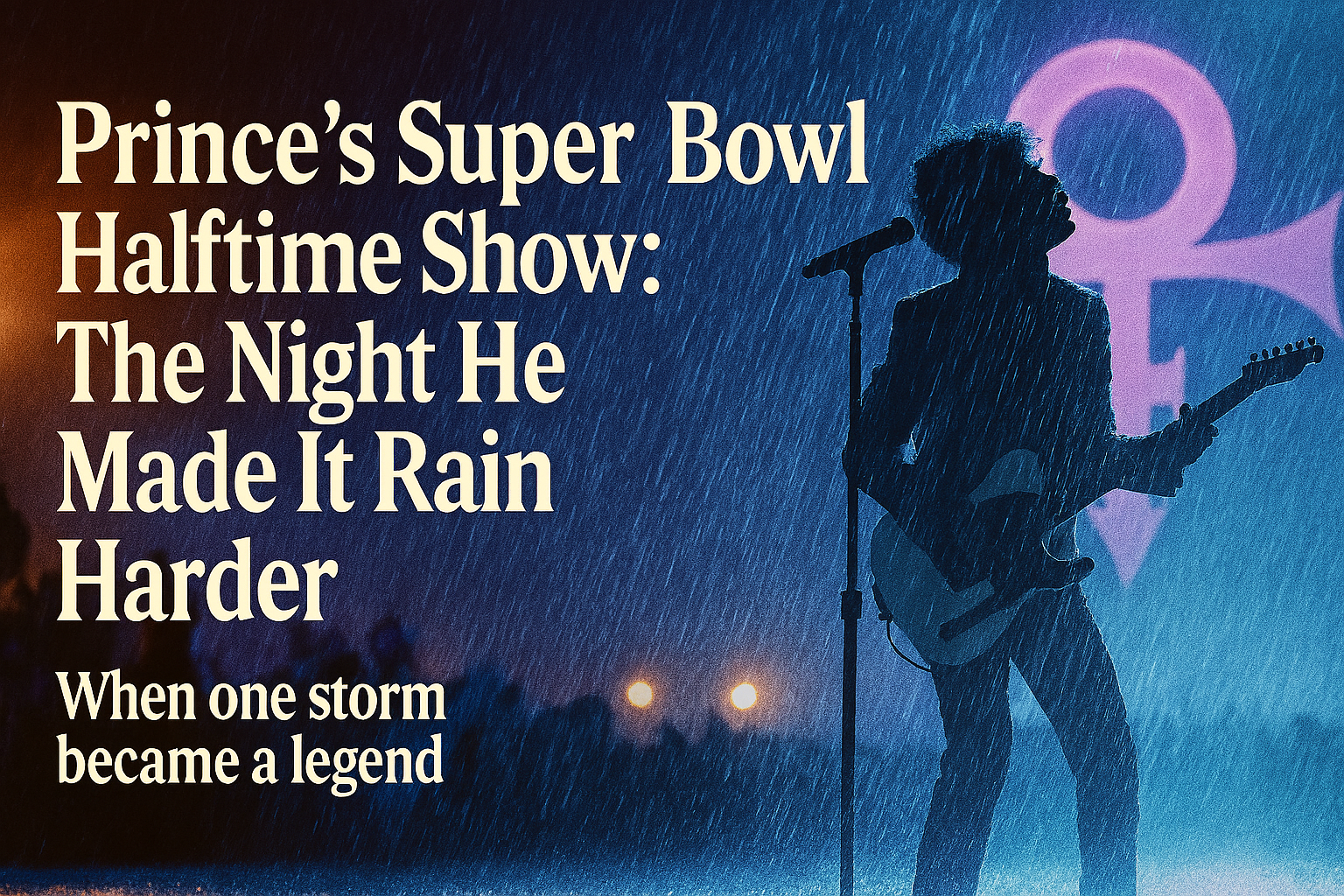
As stagehands scrambled to protect equipment from the downpour, Prince reportedly looked skyward and asked, “Can you make it rain harder?” That single line captured his defiance and confidence. Rather than retreat from the storm, he embraced it, turning the weather into a dramatic backdrop.
The stage itself was shaped like his iconic “Love Symbol,” glowing purple against the slick, rain‑soaked field. The conditions were treacherous—slippery surfaces, electrical hazards, and live television—but Prince seemed unfazed. His decision to lean into the chaos set the tone for what would become one of the most unforgettable live performances ever broadcast.
A Setlist for the Ages
Prince’s setlist was a masterclass in pacing and emotional resonance. He opened with “We Will Rock You” before sliding into “Let’s Go Crazy,” immediately igniting the crowd. The choice to begin with Queen’s anthem was bold, signaling that this was not just a showcase of his own catalog but a celebration of rock itself.
From there, he moved seamlessly into “Baby I’m a Star,” a jubilant declaration of self‑confidence that felt tailor‑made for the occasion. The rain glistened on his guitar as he danced across the stage, every movement amplified by the storm.
The medley continued with covers of Creedence Clearwater Revival’s “Proud Mary” and Bob Dylan’s “All Along the Watchtower,” each reinterpreted through Prince’s unique lens. His guitar work was fiery, his vocals commanding, and the arrangements fresh yet reverent. These choices underscored his versatility, reminding viewers that Prince was not confined to one genre—he was rock, funk, soul, and blues all at once.
The emotional peak arrived with “Purple Rain.” As the opening chords rang out, the stadium seemed to hold its breath. The song, already iconic, took on new meaning as the rain poured down harder, blurring the line between lyric and reality. Prince stood silhouetted against the storm, his guitar solo soaring as if in dialogue with the heavens. It was a moment of pure transcendence, where art and environment fused into something larger than life.
The Visuals and Atmosphere
The broadcast captured the surreal beauty of the performance. Purple lights reflected off the wet stage, creating a shimmering effect that felt almost otherworldly. Camera angles highlighted the interplay between Prince and the storm, framing him as both conductor and participant in a cosmic drama.
The dancers, the marching band, and the stage crew all seemed energized by the weather rather than hindered. The spectacle was not polished in the traditional sense—it was raw, unpredictable, and alive. That authenticity resonated with viewers, who sensed they were witnessing something unrepeatable.
Audience Reaction
In the stadium, fans were electrified. On television, millions watched in awe as Prince turned adversity into triumph. Critics hailed the performance as one of the greatest halftime shows ever, praising his ability to command the stage under impossible conditions.
Robert Hilburn of the Los Angeles Times described it as “a performance that will be remembered as long as the Super Bowl itself.” Rolling Stone later ranked it the number one halftime show of all time. For many, it was not just entertainment—it was a spiritual experience, a reminder of music’s power to elevate and inspire.
Legacy of the Performance
Prince’s Super Bowl halftime show has endured as a benchmark for live performance. It demonstrated that true artistry thrives under pressure, that risk and vulnerability can produce moments of transcendence. The image of Prince playing “Purple Rain” in an actual downpour has become symbolic of his career: fearless, innovative, and deeply connected to something beyond himself.
In the years since, artists from Beyoncé to The Weeknd have delivered memorable halftime shows, but Prince’s remains the gold standard. It is cited not only for its musical brilliance but for its cultural impact, reminding audiences that live music can be both spectacle and sermon.
Conclusion: When Doubt Became Legend
They said he wasn’t “big enough” for the Super Bowl. Yet on that rainy night in Miami, Prince proved otherwise. With one guitar, one voice, and one storm, he transformed doubt into legend. His halftime show was more than a performance—it was a declaration of resilience, artistry, and the power of music to turn chaos into beauty.
Nearly two decades later, the memory endures. Whenever rain falls during a concert, fans recall the night Prince asked the heavens to make it rain harder. And in that recollection lies the truth: Prince didn’t just play the Super Bowl. He made history.