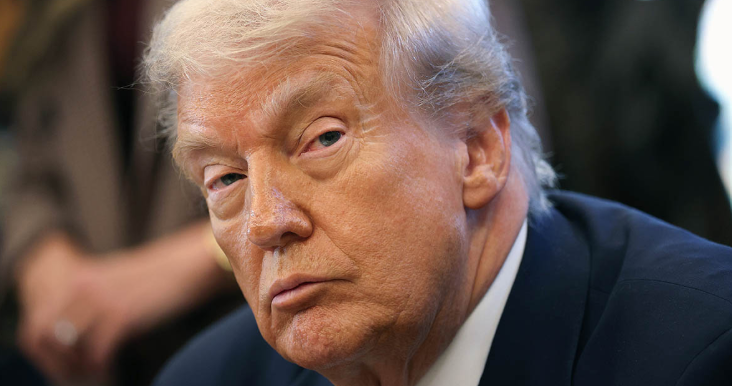
President Donald Trump’s health is constantly debated — not least because he frequently boasts about how energetic and vigorous he still is.
But what would actually happen if Trump were to die while in office?
Here’s the answer:
Donald Trump, the oldest person ever elected U.S. president, is set to turn 80 in June. He maintains that he’s in excellent health, but questions about what would happen if a sitting president were to die continue to circulate.
Some experts have even speculated that the president might have just “2 to 4 months left in the land of the living.”
Of course, predicting something like this is virtually impossible. Meanwhile, Trump frequently highlights his physical condition, claiming that doctors are impressed by his vitality. Still, sharp-eyed observers have occasionally noted unexplained bruises on his hands, fueling fresh speculation about his health.
It’s rare for a U.S. president to die in office, but it has happened. Clear procedures exist to ensure a smooth transition when it does.
What happens if a president dies in office?
The U.S. Constitution leaves no ambiguity regarding presidential succession. Should a president die, resign, be removed, or become unable to perform the duties of the office, the vice president immediately assumes power.
Article II, Section 1, Clause 6 of the Constitution states:
“In Case of the Removal of the President from Office, or of his Death, Resignation, or Inability to discharge the Powers and Duties of the said Office, the Same shall devolve on the Vice President.”
In practice, that means the vice president would be sworn in as president as quickly as possible, ensuring no gap in leadership during a crisis.
If this occurred during Trump’s term, the first major development the public would see is Vice President JD Vance taking the oath of office.
What happens next?
Once sworn in, the former vice president becomes president with full authority. They may choose to retain the existing cabinet or appoint an entirely new leadership team.
The new president can also nominate a vice president of their own choosing, though that nominee must be confirmed by both the House and the Senate.
There are also rules regarding future elections: if the new president serves less than two years of the original term, they may run for two full terms. If they serve more than two years, they are eligible for only one additional term.
A modern precedent
The last time this process occurred was in 1963 after President John F. Kennedy was assassinated. That historical example continues to shape today’s continuity-of-government procedures.
Vice President Lyndon B. Johnson was sworn in aboard Air Force One at Dallas Love Field just over two hours after Kennedy’s death. Johnson retained much of Kennedy’s cabinet, won re-election in 1964, and later chose not to seek another full term.
Eight presidents have died in office
Of the 45 men who have served as U.S. president, eight died while still in office — a surprisingly high number.
Four were assassinated: Abraham Lincoln, James A. Garfield, William McKinley, and John F. Kennedy. William Henry Harrison died of pneumonia in 1841, just a month after taking office — though the story that it was caused by skipping a coat at his inauguration has been debunked.
The other three — Zachary Taylor, Warren G. Harding, and Franklin D. Roosevelt — died from various illnesses while serving.
What could happen if Trump dies in office
If Donald Trump were to pass away while still in the White House, the situation could quickly become complicated.
Trump and his team have a history of ignoring norms, protocols, and even the rule of law, so standard procedures might not unfold perfectly.
A large, elaborate funeral would almost certainly follow. However, unlike the national unity after Kennedy’s death, today’s political climate is far more polarized. With tensions high and public discourse deeply divided — much of it shaped by Trump and his supporters — national mourning would likely be anything but universal.