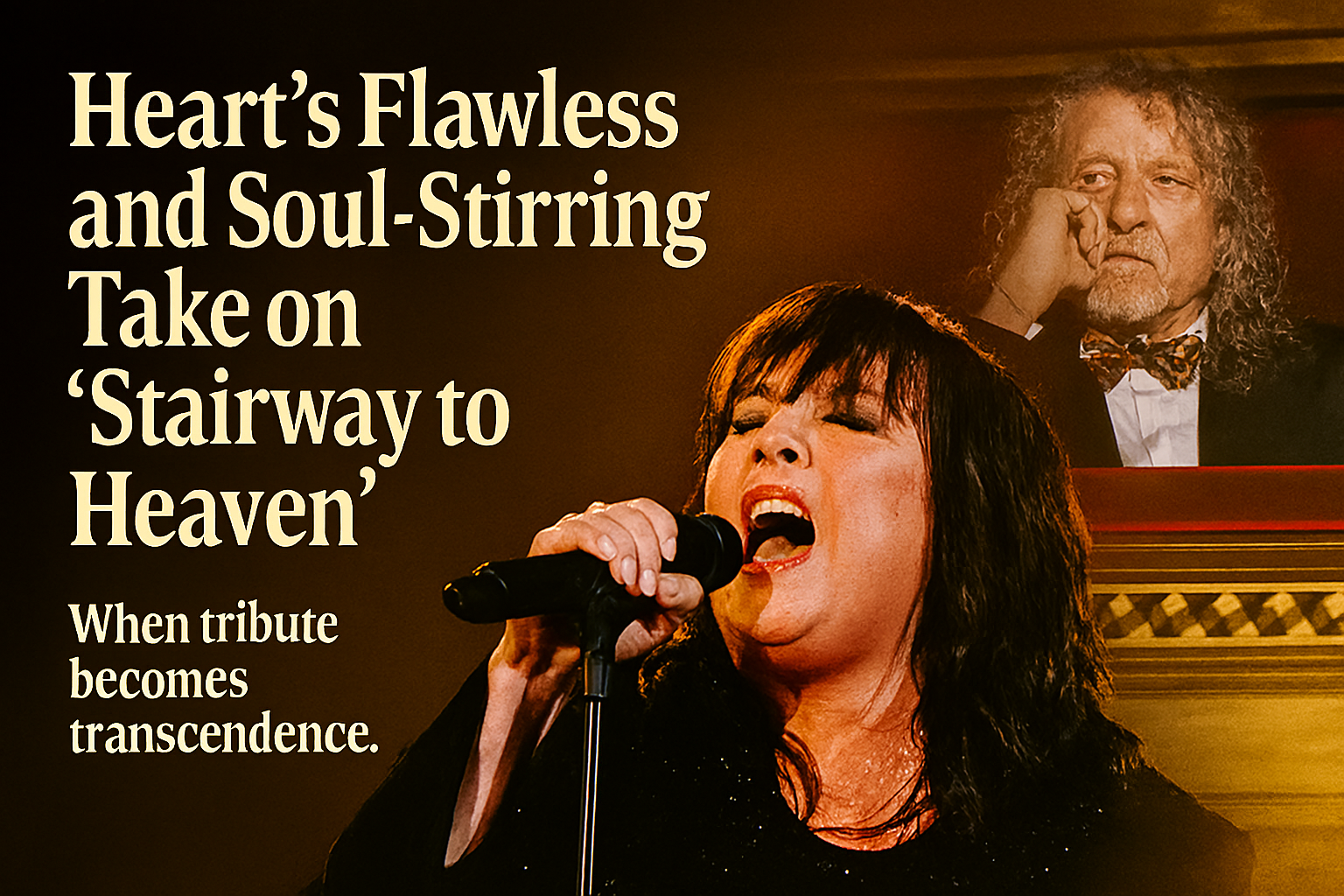
Few performances in modern music history have captured the essence of reverence, artistry, and emotional gravity quite like Heart’s rendition of Led Zeppelin’s “Stairway to Heaven” at the Kennedy Center Honors in 2012. What began as a tribute quickly transformed into a defining moment—one that not only honored the legacy of Led Zeppelin but also showcased the enduring power of Ann and Nancy Wilson as performers. Their flawless and soul-stirring take on the classic anthem remains etched in the collective memory of fans and musicians alike.
Setting the Scene
The Kennedy Center Honors is an annual celebration of artistic achievement, attended by dignitaries, celebrities, and cultural icons. That year, Led Zeppelin was among the honorees, with Robert Plant, Jimmy Page, and John Paul Jones seated in the balcony. The anticipation was palpable. “Stairway to Heaven,” arguably one of the most iconic rock songs ever written, is a piece many consider untouchable. Yet Heart, with their decades of experience and deep respect for Zeppelin’s music, were uniquely positioned to rise to the challenge.
As the lights dimmed and the first notes rang out, the audience immediately sensed they were about to witness something extraordinary.
Ann Wilson’s Voice: A Force of Nature
Ann Wilson began with the opening lines, her voice carrying both delicacy and strength. At 62, her vocal power was undiminished, and her delivery was imbued with a lifetime of emotion. Each phrase was carefully measured, balancing intimacy with grandeur. Her tone was rich, her phrasing precise, and her ability to sustain notes with effortless control gave the song a new dimension.
By the time the chorus arrived, the sheer force of her voice filled the hall, commanding attention and reverence. It was not a mere cover—it was a reimagining, a performance that honored the original while asserting its own identity.
Nancy Wilson’s Guitar: Elegance and Precision
Nancy Wilson’s acoustic guitar provided the heartbeat of the performance. Her playing was crisp, fluid, and deeply expressive. The intricate fingerpicking patterns that define “Stairway to Heaven” were executed with flawless precision, yet Nancy infused them with her own warmth and sensitivity.
Her presence on stage was understated but essential. Together, the Wilson sisters created a synergy that elevated the performance beyond technical mastery—it became a dialogue between voice and instrument, between reverence and reinvention.
Jason Bonham and the Choir: Carrying the Legacy Forward
The performance grew even more profound when Jason Bonham, son of the late Led Zeppelin drummer John Bonham, joined on drums. His presence was symbolic, bridging past and present, carrying forward the legacy of his father while honoring the band that shaped rock history.
As the choir rose behind the performers, the music swelled to its dramatic peak. The layered harmonies added a celestial quality, transforming the song into something larger than life. The combination of Ann’s soaring vocals, Nancy’s elegant guitar, Jason’s thunderous drumming, and the choir’s grandeur created a soundscape that was both monumental and deeply moving.
The Emotional Impact
Perhaps the most unforgettable moment came when cameras captured Robert Plant visibly overcome with emotion. As the choir reached its crescendo and Ann Wilson’s voice soared, Plant wiped away tears. For a man who had sung “Stairway to Heaven” countless times, to be moved so profoundly by another artist’s interpretation spoke volumes about the power of Heart’s performance.
Jimmy Page and John Paul Jones sat in quiet awe, their expressions reflecting pride and gratitude. The audience, too, was swept into the moment, rising to their feet in thunderous applause. It was not just a tribute—it was a spiritual experience, a reminder of music’s ability to transcend time and touch the soul.
A Performance for the Ages
Heart’s rendition of “Stairway to Heaven” has since been hailed as one of the greatest live performances ever captured on film. Critics praised its technical perfection, emotional depth, and sheer audacity. Fans continue to revisit the video, which has amassed millions of views online, each time rediscovering the magic of that night.
What made it so powerful was not just the flawless execution, but the sincerity behind it. Ann and Nancy Wilson approached the song with reverence, yet they infused it with their own artistry. They did not attempt to replicate Led Zeppelin—they honored them by bringing something new, something deeply personal, to the stage.
Legacy and Resonance
The performance cemented Heart’s place as one of the most respected bands in rock history. While they had long been celebrated for their own catalog of hits—“Barracuda,” “Crazy on You,” “Alone”—their ability to interpret and elevate another band’s masterpiece demonstrated their versatility and depth.
For Led Zeppelin, it was a moment of recognition and validation. To see their work honored in such a profound way reaffirmed the timelessness of their music. For audiences, it was a reminder that great songs live on, not just through recordings, but through reinterpretations that breathe new life into them.
Conclusion: When Tribute Becomes Transcendence
Heart’s flawless and soul-stirring take on “Stairway to Heaven” was more than a performance—it was a cultural milestone. It honored the past, celebrated the present, and inspired the future. It showed that music, at its best, is not about perfection alone, but about connection, emotion, and transcendence.
On that night at the Kennedy Center, Ann and Nancy Wilson, Jason Bonham, and the choir created something unforgettable. They reminded the world that “Stairway to Heaven” is not just a song—it is an experience, a journey, and a testament to the enduring power of rock and roll.