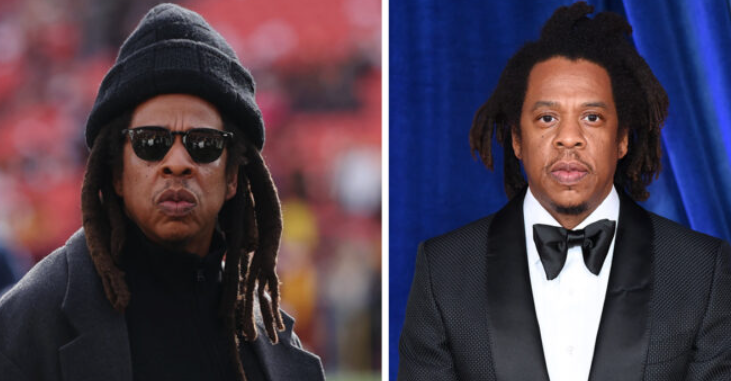
Jay‑Z has quietly introduced a new version of his name, and behind the subtle change is a personal meaning that goes deeper than it first appears.
Recently, fans noticed something different about Jay‑Z.
In announcements promoting his upcoming reunion with The Roots at the annual Roots Picnic in Philadelphia on May 30 — where he’ll perform with the group for the first time in over a decade — the hip‑hop legend appears on the lineup not as Jay‑Z, but as JAŸ‑Z, complete with an umlaut.
At first glance, it may seem like a small stylistic tweak, but the decision reaches far deeper into his past than many realized.
Return to an earlier identity
The umlaut isn’t new for the Grammy‑winning artist, born Shawn Carter. It actually dates back to the very beginning of his career. Artwork from his 1996 debut album Reasonable Doubt, along with early singles like “Ain’t No N***a,” “Can’t Knock the Hustle,” and “Feelin’ It,” featured the same distinctive mark.
By bringing it back now, the “99 Problems” rapper seems to be reconnecting with the foundation of his career — a full‑circle moment that reflects both longevity and evolution. The change has already appeared across major streaming platforms, including Spotify, Apple Music, YouTube, and Tidal, signaling that this is more than a one‑off visual update.
Instead, it feels like a deliberate nod to where it all began — a way of revisiting the identity he built long before becoming one of the most influential figures in music and business.
A history of reinventing his name
This isn’t the first time the 56‑year‑old has refined how the world sees his name. Over the years, each adjustment has marked a new chapter in his career.
In 2013, he made headlines by dropping the hyphen entirely, becoming simply JAY Z.
The move sparked confusion — and amusement — among fans and media. Billboard editor Joe Levy wrote on X, “Breaking: Jay Z has dropped the hyphen from his name, according to his label. I am not kidding. (Wish I was.) Copy editors: take note.”
JAŸ‑Z later explained the decision: “The hyphen was really big back in the day. It’s not useful anymore. You change with the times.”
“I had umlauts over one of the letters,” he added. “I removed the umlaut, too.”
Return of the hyphen — and now the umlaut
But the evolution didn’t stop there. By the time he released his 2017 album 4:44, the hyphen had returned, along with a fully capitalized version of his name.
His team even issued a statement: “‘Jay Z’ is now a relic of the past, consigned to the dustbin of history. In its place stands JAY‑Z, now with the hyphen back in its place and the whole name in all‑caps.”
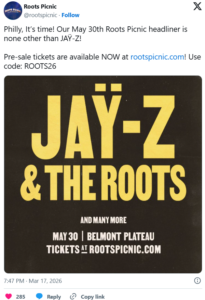
Now, with the introduction of JAŸ‑Z, the artist appears to be blending past and present — restoring an element from his early years while maintaining the identity he has built over decades.
Family names carry meaning
For JAŸ‑Z, names are more than branding — they’re personal. That philosophy extends into his family life with his wife, 35‑time Grammy winner Beyoncé.
Speaking about their daughter Blue Ivy, he explained that her name developed naturally. “We [were] calling her Blueberry. Like, ‘Look at the little blueberry.’ It was like a nickname,” he told CBS Mornings in 2023. “It just was natural. We just took the ‘berry’ off and called her Blue.”
He shared similar intentions behind the names of their 8‑year‑old twins, Rumi and Sir.
“Rumi is our favorite poet, so it was for our daughter,” he said on the Rap Radar podcast in 2017. As for Sir, “Sir was like, man, come out the gate. He carries himself like that.”
What do you think?
Is the name tweak meaningful, or just a small detail most people won’t notice? Share your thoughts — and pass this story along to see what others think.