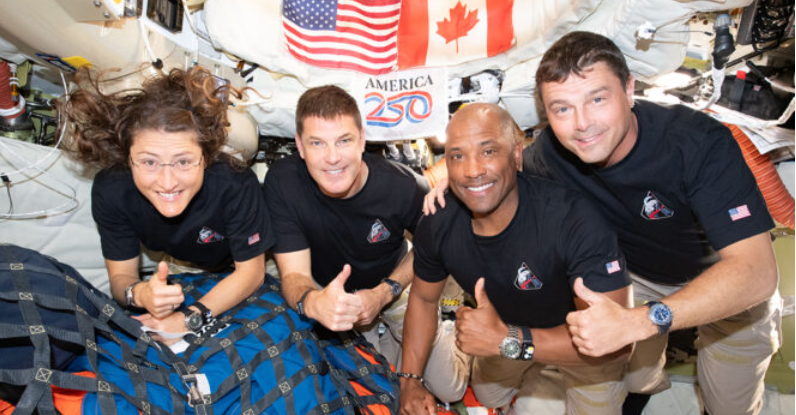
Much has rightly been said about the journey of Artemis II around the far side of the Moon. Astronauts Victor Glover, Christina Koch, Jeremy Hansen, and Reid Wiseman set a new record for the farthest distance humans have ever traveled from Earth, while also reigniting widespread public interest in space exploration.
The nine-day lunar flyby, launched by NASA on April 1, 2026, marked the first crewed mission to venture beyond low Earth orbit since the Apollo 17 mission in 1972.
The mission served as a crucial test, helping to pave the way for future Artemis missions aimed at landing humans on the Moon within the coming years.
The crew safely splashed down in the Pacific Ocean at 8:07 p.m. EDT on April 10, 2026, after traveling an impressive 252,756 miles from Earth.
Although they returned without harm from their historic journey, the Artemis II crew may still have experienced physical changes due to the nine days spent in space.
If you’re wondering whether traveling farther into space than any human before comes with effects on the body, you’re not alone. Reports suggest that such journeys can bring certain changes, and astronauts venturing beyond Earth’s orbit may face additional challenges in the future.
According to Sky News, this type of travel exposes astronauts to high-energy radiation. On Earth, the atmosphere and the planet’s magnetic field act as a protective barrier known as the magnetosphere. Once astronauts move beyond this shield, they no longer benefit from that protection.
As a result, they may face an increased risk of cancer, DNA damage, neurodegenerative effects, cardiovascular problems, and disruptions to the immune system.
Dr. Haig Aintablian, director of space medicine at UCLA, told Sky News: “Once you go beyond low Earth orbit, you lose much of the protection of Earth’s magnetic field.”
In addition, astronauts on longer missions experience the effects of microgravity on their bodies. While it may not sound severe at first, the impact can be more significant than many expect.
“The body is built to live and work in gravity,” Dr. Aintablian explained. “When that gravity signal is removed, the inner ear must recalibrate, muscles and bones are used differently, and fluids shift upward toward the head.
“That is why we can see changes in balance, strength, and in some cases, vision.”
According to NASA, for every month spent in space, a person’s weight-bearing bones can lose about 1% of their density if no preventive measures are taken. Astronauts may also experience muscle atrophy, or weakening of the muscles, while away from Earth.
Some astronauts report symptoms such as headaches, motion sickness, dizziness, reduced cardiovascular conditioning, and sleep disturbances.
Fortunately, Dr. Aintablian noted that many of these effects tend to fade after returning to Earth.
He added: “Some changes can take longer to recover from, and a few, particularly those involving vision or bone, can persist beyond the mission.”
As for how NASA is monitoring the physical effects on the Artemis II crew, Dr. Aintablian explained: “On a mission like Artemis II, doctors are tracking not just how the crew feels, but how their bodies are responding in real time.”
He added: “There is a wide range of evaluations, including blood and other biological samples, balance and vestibular testing, strength and cardiovascular assessments, sleep monitoring, and behavioral health checks.”