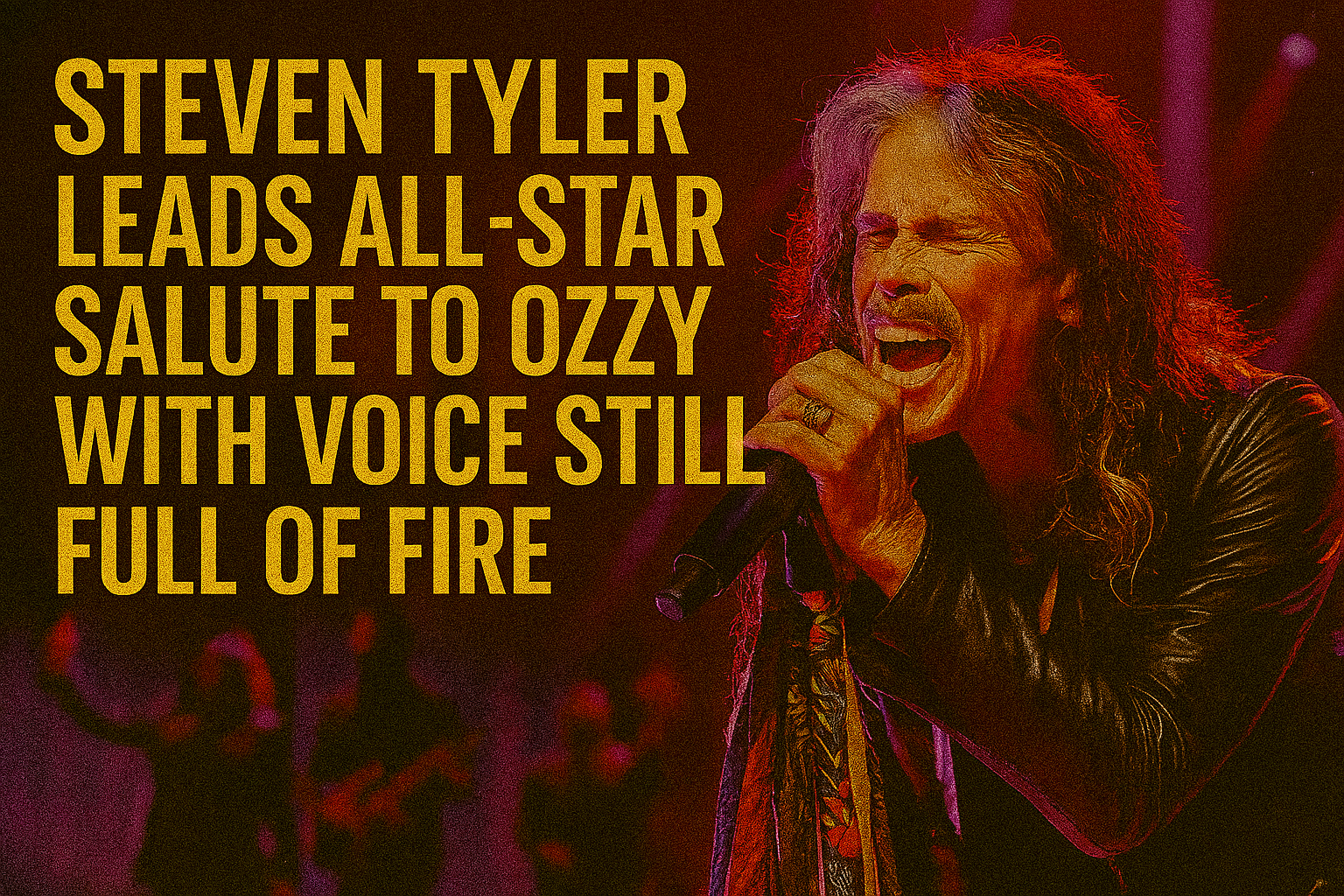
At the 2025 MTV Video Music Awards, Steven Tyler proved that age is no match for raw rock energy. The Aerosmith frontman, now 77, led an electrifying all-star tribute to Ozzy Osbourne that left the crowd stunned and the internet ablaze. With his signature scarves, primal screams, and a voice still brimming with fire, Tyler reminded the world why he remains one of rock’s most enduring forces.
A Tribute Fit for the Prince of Darkness
The tribute, titled “Ozzy Osbourne: Back to the Beginning,” was a celebration of Ozzy’s legacy—from Black Sabbath’s thunderous beginnings to his solo career’s emotional depth. The performance featured a medley of Ozzy’s most iconic tracks: “Crazy Train,” “Changes,” and “Mama, I’m Coming Home.” Tyler was joined by fellow legends Joe Perry, YUNGBLUD, and Nuno Bettencourt, each bringing their own flavor to the sonic feast.
But it was Tyler who stole the spotlight. Draped in leather and drenched in purple light, he launched into “Mama, I’m Coming Home” with a tenderness that melted into fury. His voice, once feared to be silenced by vocal cord injuries, soared with grit and grace.
A Voice That Refuses to Fade
Tyler’s appearance marked his first major performance since Aerosmith retired from touring due to his vocal health. Many wondered if he’d ever return to the stage. But when he grabbed the mic, it was clear: the fire hadn’t gone out—it had simply been waiting.
His rendition of “Whole Lotta Love,” a surprise addition to the set, was pure rock resurrection. With screams that blurred the line between past and present, Tyler summoned the spirit of Zeppelin and the fury of Sabbath in one breath.
Fans and critics alike were floored. “It wasn’t a cover,” one reviewer wrote. “It was a resurrection.”
The Power of Collaboration
The tribute wasn’t just about Tyler. Joe Perry’s guitar work was razor-sharp, channeling the chaos of “Crazy Train” with surgical precision. YUNGBLUD brought youthful energy and emotional vulnerability to “Changes,” while Nuno Bettencourt’s solos added a layer of virtuosity that elevated the entire set.
Together, the ensemble created a tapestry of sound that honored Ozzy’s legacy without mimicking it. It was reverent, raw, and real.
Ozzy’s son Jack introduced the segment with a heartfelt video message: “I know for sure it would make him incredibly happy to see these great musicians carry on his legacy and help inspire the next generation of rockers.”
A Legacy That Lives On
Ozzy Osbourne, now retired from touring due to health issues, watched the tribute from backstage. Though absent from the stage, his presence was felt in every note. The performance wasn’t just a celebration—it was a passing of the torch.
Tyler’s ability to channel Ozzy’s spirit while maintaining his own identity was a masterclass in tribute artistry. He didn’t try to become Ozzy. He honored him by being unapologetically Steven Tyler.
The Internet Reacts
Within hours, clips of the performance flooded social media. Fans praised Tyler’s vocals, the chemistry between the performers, and the emotional weight of the tribute. Reaction videos showed viewers crying, cheering, and replaying the set on loop.
Music blogs called it “the best moment of the VMAs.” Rock forums lit up with praise. Even younger audiences unfamiliar with Ozzy’s full catalog were drawn in by the sheer power of the performance.
Why It Mattered
This tribute wasn’t just another award show segment. It was a reminder of rock’s emotional depth, its ability to connect generations, and its refusal to fade quietly. Tyler’s voice—still full of fire—became a symbol of resilience, passion, and legacy.
For Ozzy, it was a love letter. For Tyler, it was a rebirth. And for the rest of us, it was proof that rock still matters.