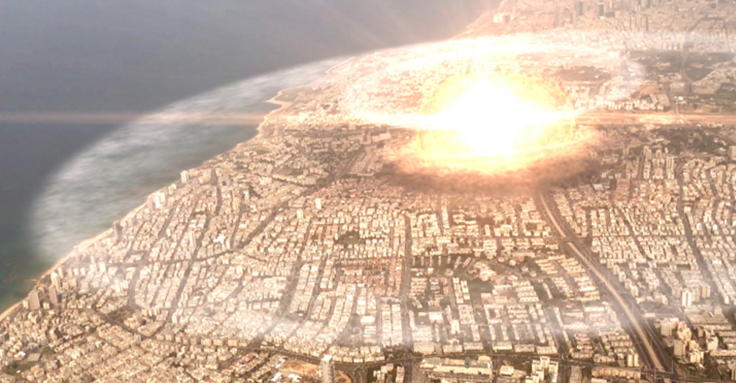
As global tensions rise following U.S. and Israeli airstrikes on Iran over the weekend, many Americans are asking a chilling question: if the conflict escalates into World War III, where in the country would you actually have the best chance of survival?
Accused Iran of restarting its nuclear program
There was a time when American students were taught what to do in the event of a nuclear attack, when the Soviet Union was seen as the nation’s greatest threat. The so-called “duck and cover” drills had children hiding under desks to brace for a Soviet nuclear strike, creating a sense of preparedness despite offering little real protection.
Today, the world looks very different. But with the U.S. now engaged in military conflict with Iran, some fear those old anxieties may be resurfacing.
President Donald Trump and his aides have claimed that Iran has restarted its nuclear program, has enough fissile material to build a bomb within days, and is developing long-range missiles capable of reaching the United States. All three claims are either false or unproven, according to The New York Times — yet that has not stopped the U.S. from launching strikes on Iran.
The joint mission, called Operation Epic Fury, struck multiple Iranian cities including Tehran, Isfahan, Tabriz, Kermanshah, and Qom, according to Sky News, and reportedly killed Supreme Leader Ayatollah Ali Khamenei, who had ruled the country for more than three decades.
While Trump has warned Iran against retaliation, analysts fear that any counterstrike could target U.S. nuclear missile silos, dangerously escalating the conflict.
2,000 nuclear warheads
Most of America’s roughly 2,000 nuclear warheads are based in Montana, North Dakota, and Nebraska, with smaller stockpiles in Wyoming and Colorado, according to Nuclear Forces.
A direct hit on these facilities could release catastrophic radiation. States housing missile silos — including Montana, Wyoming, Colorado, Nebraska, South Dakota, North Dakota, Iowa, and Minnesota — could face radiation levels ranging from 1 Gy to 84 Gy, while just 8 Gy is considered lethal.
For this reason, analysts cited by Newsweek suggest that states located farther from nuclear infrastructure may offer better odds of survival.
Their list includes: Maine, New Hampshire, Vermont, Massachusetts, Rhode Island, Connecticut, New York, New Jersey, Pennsylvania, Delaware, Maryland, Washington D.C., Virginia, West Virginia, North Carolina, South Carolina, Georgia, Florida, Alabama, Mississippi, Tennessee, Kentucky, Ohio, Indiana, and Michigan. Other relatively safer states include Washington, Utah, New Mexico, and Illinois.
“This assessment is based on the average radiation exposure risk calculated for each latitude and longitude point, using a scale that measures the estimated cumulative radiation dose after four days in grays (Gy), a unit used to measure ionizing radiation,” Newsweek explained.
Long-term survival – two places
Even if certain states may be somewhat shielded from the initial blast, experts caution that no location in the U.S. would be entirely safe in a full-scale nuclear war.
Scientific American warned in 2023 that “a coordinated nuclear attack on existing U.S. silo fields — in Colorado, Wyoming, Nebraska, Montana, and North Dakota — would wipe out all life in nearby regions and contaminate fertile farmland for years.”
For those thinking about long-term survival, geography becomes even more critical. Investigative journalist Annie Jacobsen told Steven Bartlett on The Diary of a CEO podcast that Southern Hemisphere nations such as New Zealand and Australia would offer the strongest chance of surviving a nuclear winter.
“Places like Iowa and Ukraine would be covered in snow for 10 years,” Jacobsen said. “Agriculture would collapse, and when agriculture collapses, people die.”
She added that radiation and a weakened ozone layer could make sunlight dangerous across much of the planet, forcing survivors underground and potentially triggering violent competition for food. “Everywhere except New Zealand and Australia,” she noted, “those are the only places that could realistically sustain agriculture.”
Beyond food security, their distance from major nuclear powers also makes them less likely targets in an initial strike.
Jacobsen’s conclusion is stark: “No one is truly safe in a nuclear war. But if you’re looking for the best possible odds of survival — and the ability to grow food while much of the world freezes — head down under.”