When the NFL booked Prince for the Super Bowl XLI Halftime Show, some doubted whether one man with a guitar could command the world’s biggest stage. But on February 4, 2007, under a sky that refused to cooperate, Prince didn’t just rise to the moment — he reshaped it. What unfolded that night wasn’t merely a performance; it was a rain‑defying moment that turned a storm into a stage light and transformed doubt into legend.
The night began with tension. Miami’s Dolphin Stadium was drowning in relentless rain, the kind that turns stages slick and instruments dangerous. Producers scrambled, dancers hesitated, and technicians whispered about safety. But Prince? He didn’t flinch. When told the rain might complicate the show, he famously asked, “Can you make it rain harder?” It wasn’t bravado — it was prophecy. He understood something no one else did: the storm wasn’t an obstacle. It was an amplifier.
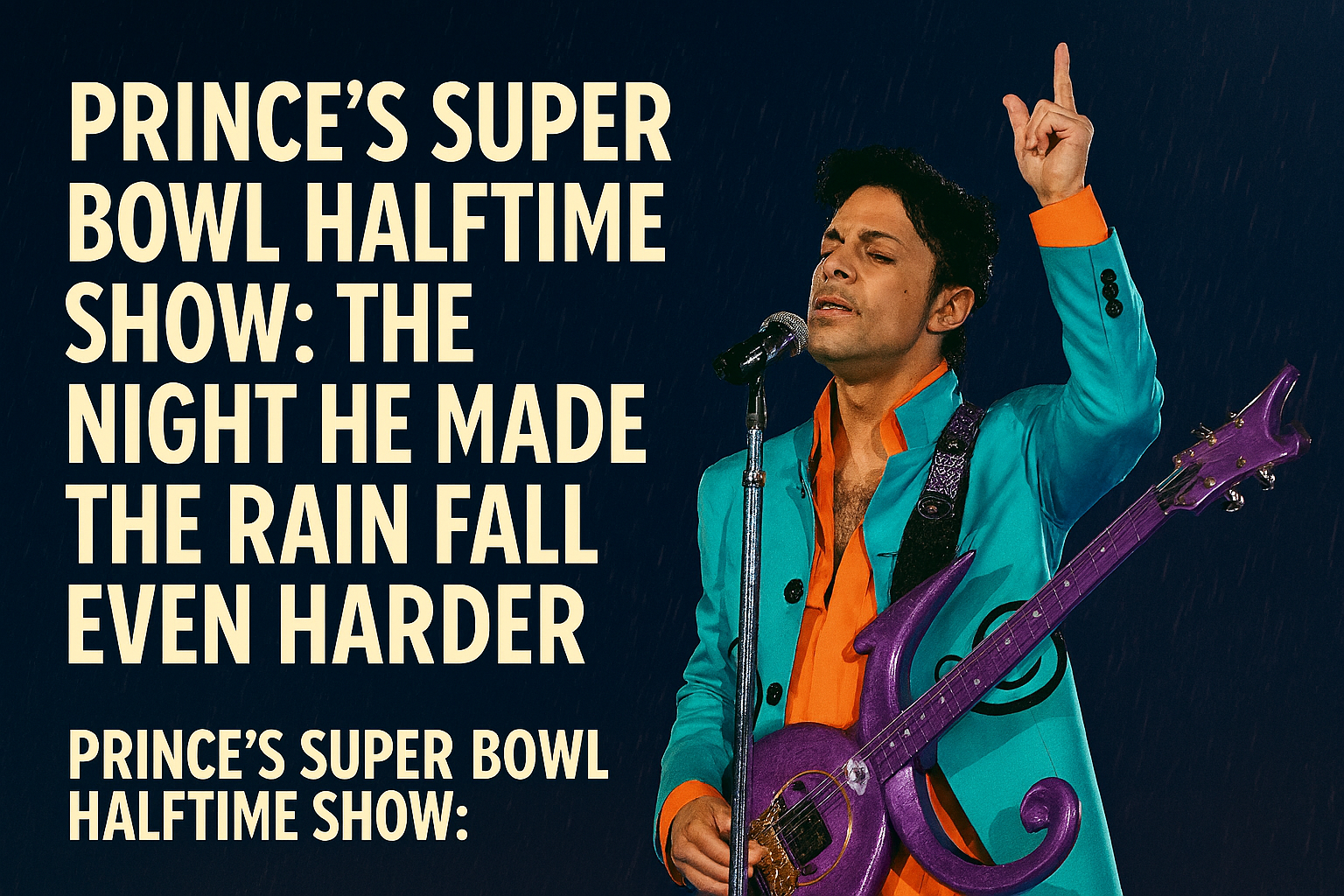
As the opening chords of “Let’s Go Crazy” cut through the downpour, Prince emerged like a silhouette carved from lightning. His turquoise suit glowed against the storm, and his presence alone shifted the energy of the stadium. The rain didn’t dampen the moment; it sharpened it. Every drop became part of the choreography, every flash of light a cue. The crowd, soaked and electrified, roared as if witnessing a miracle.
Prince moved across the stage with the confidence of someone who had already conquered the night. His dancers slid across the wet platform with impossible precision, their movements synchronized with the storm itself. The band played with a ferocity that matched the weather, turning the halftime show into a storm‑charged spectacle. And through it all, Prince remained untouched by hesitation, his voice slicing through the rain with clarity and fire.
The setlist was a masterclass in pacing. After igniting the stadium with “Let’s Go Crazy,” he transitioned into “Baby I’m a Star,” a declaration that felt almost unnecessary — the world already knew. But it was the medley that followed that revealed his genius. Prince wove together “Proud Mary,” “All Along the Watchtower,” and the Foo Fighters’ “Best of You,” transforming each song into something unmistakably his. It was a reminder that he wasn’t just a performer; he was an interpreter, a transformer, a vessel for sound.
But the moment that sealed the night — the moment that turned a great performance into a myth — came when the opening notes of “Purple Rain” echoed through the stadium. The symbolism was too perfect to ignore. A man named Prince, standing in a storm, playing a song about purple rain while actual rain poured from the sky. It felt scripted by the universe.
As he stepped onto the illuminated stage shaped like his iconic symbol, the camera captured a silhouette that would become one of the most unforgettable images in music history. Prince stood tall, guitar in hand, framed by sheets of rain and violet light. The storm intensified, as if answering his earlier challenge. And instead of retreating, he leaned into it, letting the rain cascade down his guitar as he unleashed a solo that seemed to split the sky.
The crowd was transfixed. Millions watching at home felt the electricity through their screens. The rain, once a threat, had become part of the music — a living instrument. Prince didn’t fight the storm; he collaborated with it. His performance became a cosmic duet with the weather, a moment where nature and artistry collided in perfect harmony.
As “Purple Rain” reached its emotional peak, Prince lifted his guitar toward the heavens, letting the storm baptize the moment. The final notes rang out like a declaration: greatness isn’t measured by conditions, but by how you rise above them. When the lights dimmed and the stadium erupted in applause, it was clear that something historic had just taken place.
In the days that followed, critics hailed the performance as one of the greatest halftime shows ever — not because of pyrotechnics or elaborate staging, but because of the raw, undeniable power of one artist refusing to be overshadowed by circumstance. Prince didn’t just perform in the rain. He commanded it. He shaped it. He turned it into part of his legend.
Today, nearly two decades later, the performance remains a benchmark for live music. It’s studied, celebrated, and replayed by fans who understand that what happened that night cannot be replicated. It wasn’t just talent. It wasn’t just showmanship. It was destiny meeting preparation, artistry meeting courage, and a storm meeting the one man capable of outshining it.
Prince’s Super Bowl Halftime Show wasn’t simply a concert. It was a moment when the sky opened, the world watched, and a legend proved — once again — that he was built for the extraordinary.