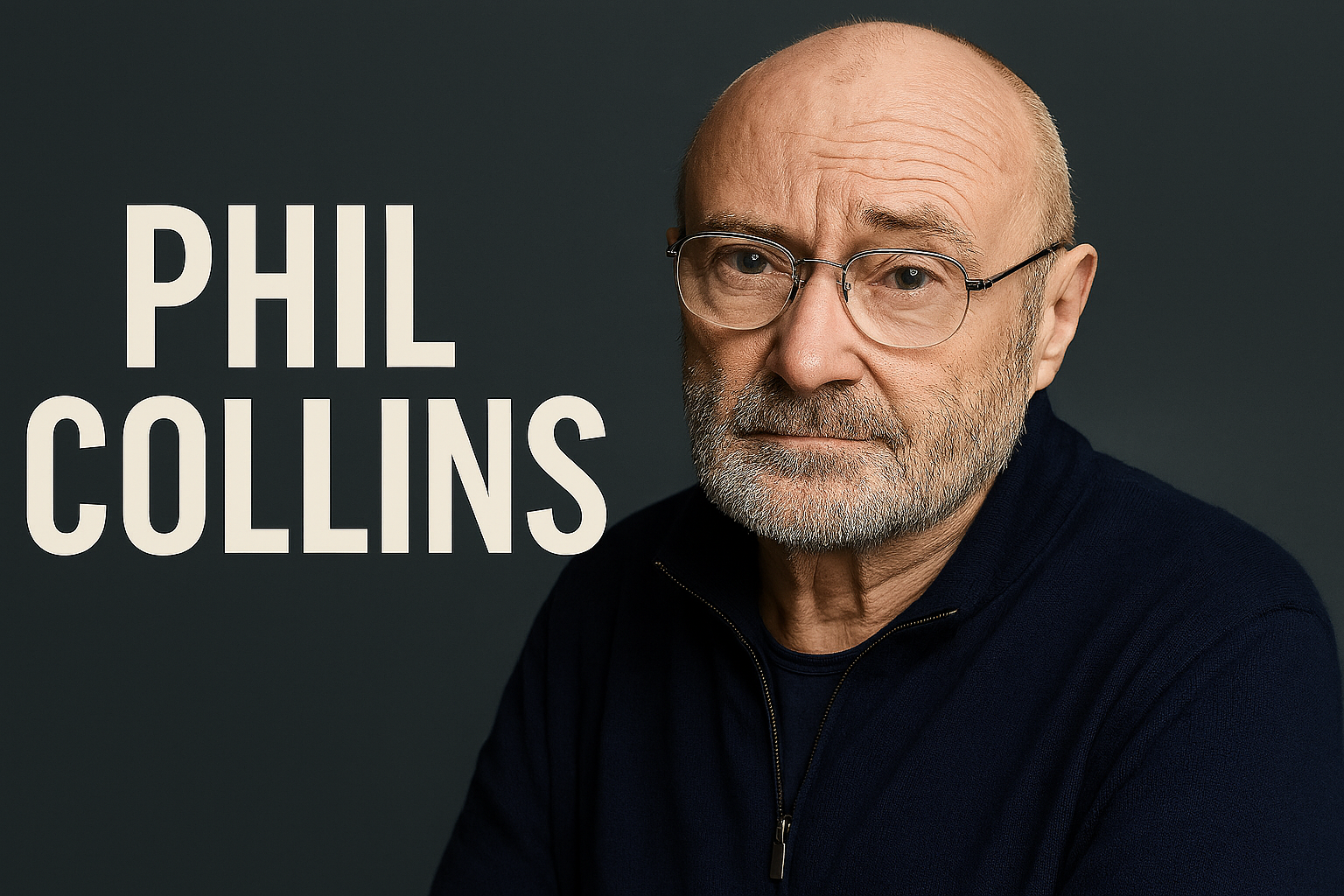
Few artists in modern music have shaped pop culture as profoundly as Phil Collins. For more than five decades, he has been a defining voice in rock, pop, and film, leaving behind a legacy that spans chart‑topping hits, iconic drum breaks, and unforgettable performances. His journey — from child actor to global superstar to a man confronting profound health challenges — is a story of talent, reinvention, and remarkable endurance.
Born on January 30, 1951, in London, Collins grew up in a household that encouraged creativity. His mother worked in the theatre world, and his early exposure to performance shaped his artistic instincts. By age five, he had already received his first drum kit, a gift that would quietly set the course for his future. While many children drift from early hobbies, Collins’ fascination with rhythm only deepened. He practiced relentlessly, often playing along to records by The Beatles, Motown artists, and jazz drummers who would later influence his distinctive style.
Before music became his primary focus, Collins spent several years as a child actor. He appeared in stage productions and even landed small roles in films such as A Hard Day’s Night and Chitty Chitty Bang Bang. Though acting never became his long‑term path, the experience gave him confidence and stage presence — qualities that would later define his career as a frontman.
His life changed dramatically in 1970 when he auditioned for Genesis, a progressive rock band searching for a new drummer. Collins arrived early, swam in the auditioning pool to relax, and listened to the other drummers try out — a stroke of luck that allowed him to learn the songs before his turn. His audition was so strong that the band hired him almost immediately. For the next five years, Collins anchored Genesis with his inventive drumming, complex rhythms, and subtle harmonies.
When lead singer Peter Gabriel left the band in 1975, Genesis auditioned dozens of vocalists. None fit. Eventually, Collins — who had been singing guide vocals during rehearsals — stepped up to the microphone. His warm, emotional voice transformed the band’s sound, helping Genesis evolve from a cult progressive act into a mainstream powerhouse. Albums like A Trick of the Tail, Duke, and Invisible Touch cemented their global success.
But Collins’ ambitions extended beyond the band. In 1981, he released his debut solo album, Face Value, featuring the haunting, atmospheric track “In the Air Tonight.” The song’s explosive drum break became one of the most recognizable moments in music history. His solo career quickly skyrocketed, producing hits such as “Against All Odds,” “One More Night,” “Sussudio,” and “Another Day in Paradise.” By the late 1980s, Collins was one of the most successful artists in the world, dominating charts and award shows while maintaining his role in Genesis.
His influence extended into film as well. In 1999, Collins composed the soundtrack for Disney’s Tarzan, earning an Academy Award for the song “You’ll Be in My Heart.” His ability to blend emotional storytelling with musical craftsmanship made the soundtrack one of Disney’s most beloved.
Despite his success, Collins’ personal life was often turbulent. He went through multiple divorces, struggled with the pressures of fame, and faced criticism for being “overexposed” during the height of his popularity. Yet he continued to create, perform, and evolve — even as the music industry shifted around him.
In the 2000s, Collins began experiencing serious health issues. Years of drumming had taken a toll on his body. Nerve damage in his hands made it difficult to play drums, and spinal problems affected his mobility. He underwent multiple surgeries, but complications persisted. By the mid‑2010s, Collins often performed seated, relying on canes or assistance to move onstage. Still, he refused to step away from music entirely.
His “Not Dead Yet” tour, launched in 2017, was both a comeback and a statement of resilience. Fans around the world filled arenas to see him perform, celebrating not just his music but his determination. In 2022, Collins played what he described as his final show with Genesis, marking the end of an extraordinary era.
In recent years, Collins has spoken candidly about his declining health. He has acknowledged the challenges of aging, chronic pain, and limited mobility, yet he remains deeply connected to music through writing, producing, and mentoring. His son, Nic Collins, has taken up the mantle as a drummer, performing alongside him on tour — a passing of the torch that has moved fans worldwide.
Phil Collins’ legacy is vast. He has sold more than 100 million records as a solo artist and another 100 million with Genesis. He is one of the few musicians to achieve No. 1 hits in three different decades. His voice, songwriting, and drumming have influenced generations of artists across genres.
But beyond the numbers, Collins’ story resonates because it is human. It is the story of a boy who fell in love with rhythm, a man who rose to global fame, and an artist who continues to inspire despite profound physical challenges. His music — emotional, honest, and timeless — remains a soundtrack to millions of lives.
Phil Collins may no longer command the stage as he once did, but his impact endures. His songs continue to echo across decades, reminding the world that true artistry is not defined by perfection, but by passion, vulnerability, and the courage to keep going.