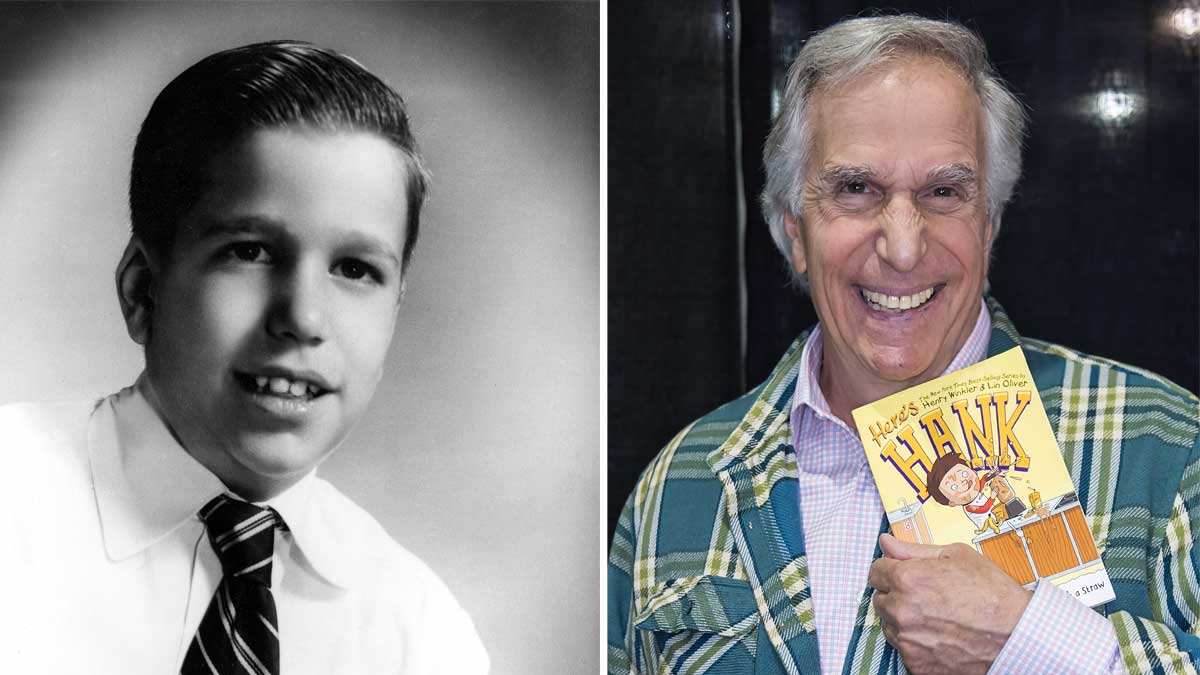
Henry Winkler, the actor who turned Arthur “Fonzie” Fonzarelli into the coolest man on 1970s television, did not read a single book until he was 31. That was the year he found out he had dyslexia, a discovery that came only after his stepson was tested for a learning disability.
By then, he was already famous for playing The Fonz. Millions of viewers knew him as the unflappable guy in the leather jacket. Almost none of them knew he had spent his whole life convinced he was stupid. wabe
Grounded for most of high school
Winkler’s parents were German Jewish immigrants who placed enormous value on education. When their son’s grades fell short, they decided he simply wasn’t trying. He has said he was labeled lazy and stupid and told again and again that he was not living up to his potential.
He didn’t accept that. As far as he was concerned, he was working as hard as he could.
The punishment was grounding, and plenty of it. Winkler has described spending most of his high school years confined to his desk, sometimes for six weeks at a time, on the theory that enough hours there would cure the “laziness.” It also kept him out of school dances and school plays.
Growing up in New York City, he took the same geometry course over and over, summer sessions included, and was relieved when he finally passed with a D-minus. wabe
The constant criticism wore down his confidence. Years later, he vowed he would never speak to his own children that way.
Against the odds, he made it to Yale, where he earned a master’s degree in drama.
Bluffing through the Happy Days table reads
Graduate school did not solve the reading problem. Scripts became the new obstacle.
Winkler has explained that he learned to work around it. He memorized as much as he could, improvised the rest, and delivered everything with total conviction. Sometimes the ad-libs made casting directors laugh. Sometimes they got him the job.
That habit carried him all the way to Happy Days. His first audition for the show came in October 1973, when he was almost 28, older than most people playing high schoolers, and still struggling with something he didn’t know had a name. The Fonz was written as a secondary character, but within a few episodes he had become the show’s main draw. nbcsandiegowritersdigest
Behind the scenes, Monday mornings were a weekly ordeal. The cast read the new script aloud around a table with the producers, director and department heads. For ten years, Winkler has said, he stumbled over nearly every word and left embarrassed. The saving grace was his memory. Once a script was well written, he could absorb it quickly and perform it without the page.
How Henry Winkler’s dyslexia was finally spotted
The breakthrough came through family. Winkler has recalled that his stepson was bright, funny and highly verbal, yet his schoolwork was a mess of smudges and erasures. When the boy was tested and diagnosed with dyslexia, Winkler realized that everything being said about his stepson also applied to him. indiebound
His reaction, as he has told it, was simple: “I have something with a name.”
At 31, he was diagnosed himself. Books had always made him anxious, and that year he finally read one.
Relief soon gave way to anger. All the arguments at home, all the weeks of grounding, had been for nothing. He hadn’t been lazy. His brain simply processed written language differently.
The condition is far from rare. Dyslexia is an inherited reading disability that makes it hard to connect the sounds of speech with letters, and it affects roughly one in ten Americans. For readers who grew up in the 1950s and 1960s, as Winkler did, a child who couldn’t keep up was often written off rather than tested. wabe
From Fonzie to Hank Zipzer
Winkler turned that frustration into something useful. After a Broadway show he was in closed in 2002, his agent, Alan Berger, suggested he write children’s books about growing up with dyslexia. Winkler’s first response was that he couldn’t, because he had dyslexia. Berger introduced him to Lin Oliver, an experienced children’s author and co-founder of the Society of Children’s Book Writers and Illustrators. writersdigest
The pair began the Hank Zipzer series in 2003. Its hero is a schoolboy with dyslexia whose misadventures closely mirror Winkler’s own childhood. The books have sold more than 3 million copies in the United States. ldonlinesmithsonianassociates
Children write to him about Hank, and Winkler has said he answers every one of those letters. In each reply, he tells the child that a learning challenge will not stop them from reaching their dream, and that the only thing that can is giving up on themselves.
He has won plenty of awards for his screen work, including, his first primetime Emmy for the HBO series Barry. Still, he has said that apart from his family, the books are what he is proudest of. nbcsandiego
His 2023 memoir, Being Henry: The Fonz… and Beyond, became a New York Times bestseller and addresses his diagnosis at 31 alongside his career. It opens not with fame, but on the morning of that first Happy Days audition in 1973. smithsonianassociatesnbcsandiego