Some photos send shivers down your spine, even if they weren’t meant to. A harmless snapshot can feel unsettling when viewed through the lens of history or when stripped of its context. Why does it feel so eerie? What’s the story behind it?
Throughout time, cameras have captured moments that spark curiosity, unease, and countless questions. These haunting images weren’t created to be creepy, but their mysterious details or forgotten histories make them unforgettable.
Sometimes, learning the truth behind them eases the tension—but other times, it only deepens the mystery. Ready to uncover the stories behind these chilling glimpses of the past?
Mountain of bison skulls (1892)
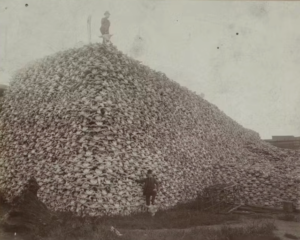
This haunting photo, taken in 1892 outside Michigan Carbon Works in Rougeville, Michigan, captures a shocking moment in history. It shows an enormous mountain of bison skulls, collected to be processed into bone glue, fertilizer, and charcoal. What makes this image so unsettling is the story it tells—not just about the exploitation of natural resources, but about a massive loss tied to colonization and industrialization.
At the start of the 19th century, North America was home to 30 to 60 million bison. By the time this photo was taken, that number had dropped to a staggering low of just 456 wild bison. The westward expansion of settlers, combined with market demand for bison hides and bones, fueled a brutal slaughter that decimated once-thriving herds. Between 1850 and the late 1870s, most herds were wiped out, leaving behind both environmental and cultural devastation.
The towering pile of bones in this photograph isn’t just a testament to industrial greed; it also reflects the deep connection between Indigenous Nations and bison—a connection forcibly severed by this large-scale destruction. The bones, stacked like a man-made mountain, blur the line between natural and manufactured landscapes, a concept later described by photographer Edward Burtynsky as “manufactured landscapes.”
Today, thanks to conservation efforts, roughly 31,000 wild bison roam North America. This photograph serves as a stark reminder of how close we came to losing them entirely—a chilling glimpse into a past shaped by choices that still echo today.
Inger Jacobsen and Bülow (1954)
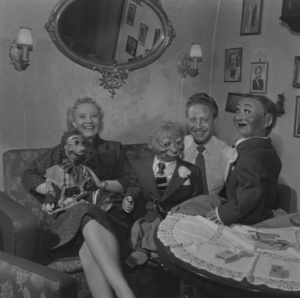
This mid-1950s photo may seem slightly eerie at first glance, but it likely captures an ordinary day in the lives of Norwegian singer Inger Jacobsen and her husband, Danish ventriloquist Jackie Hein Bülow Jantzen, better known by his stage name, Jackie Bülow.
Jacobsen was a beloved singer in Norway, even representing her country at the Eurovision Song Contest in 1962. Meanwhile, Bülow brought his unique charm and talent as a ventriloquist to audiences at a time when the art form was thriving, especially on radio and the emerging medium of television.
The photo feels like a snapshot from a bygone era—a glimpse into a world that seems far removed from today. Yet ventriloquism, while less common now, hasn’t disappeared. The skill and creativity of ventriloquists continue to captivate audiences, with performers like Terry Fator (2007), Paul Zerdin (2015), and Darci Lynne (2017) even winning America’s Got Talent. It’s proof that while the world changes, some traditions endure in unexpected ways.
The sleeping mummy trader (1875)
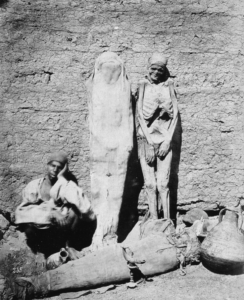
Mummies have fascinated humanity for over 2,000 years, but the way they’ve been treated throughout history reveals a strange and sometimes unsettling story.
During the Middle Ages, Europeans used mummies in unusual ways—grinding them into powder for supposed medicinal cures, turning them into torches because they burned well, or even using them to treat ailments like coughs or broken bones. This practice was driven by the mistaken belief that mummies were embalmed with healing bitumen. By the 19th century, medicinal use had declined, but fascination remained.
Grave robbers fueled the demand, and merchants shipped mummies from Egypt to Europe and America, where they became prized possessions of the wealthy. They were displayed as status symbols or used for research. One of the more bizarre trends of the 1800s was the “unwrapping party,” where mummies were ceremoniously unwrapped before curious audiences—blurring the line between science and entertainment.
This image of a merchant resting among a trove of mummies highlights how these ancient artifacts became commodities, exploited for everything from medical experiments to drawing-room spectacles. It’s a reminder of how cultural treasures were once treated—and why their preservation today is so important.
The iron lungs (1953)
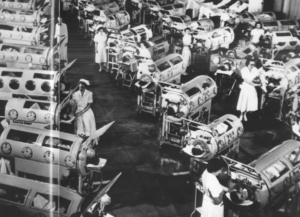
Before vaccines, polio was one of the most feared diseases in the world, paralyzing or killing thousands each year. In the U.S., the 1952 outbreak was the worst, with nearly 58,000 cases—over 21,000 people left with disabilities and 3,145 lives lost, mostly children. Polio didn’t directly damage the lungs but attacked motor neurons in the spinal cord, cutting off communication between the brain and the muscles needed to breathe.
For the most severe cases, survival often meant being confined to an iron lung—a mechanical respirator that kept patients alive by forcing air into their paralyzed lungs. Hospitals were filled with rows of these large, cylindrical machines, many occupied by children fighting for their lives. A single image of these “mechanical lungs” captures the devastating impact of polio, a chilling reminder of the fear and uncertainty families faced before the vaccine arrived in 1955.
Even for those who left the iron lung, life was often permanently changed, marked by lasting disabilities. Still, the image of endless rows of these machines stands as a testament to both the human cost of the epidemic and the resilience of those who endured it.
A young mother and her dead baby (1901)
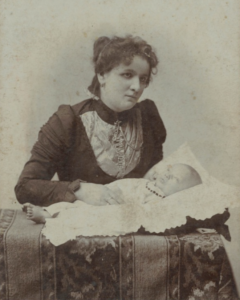
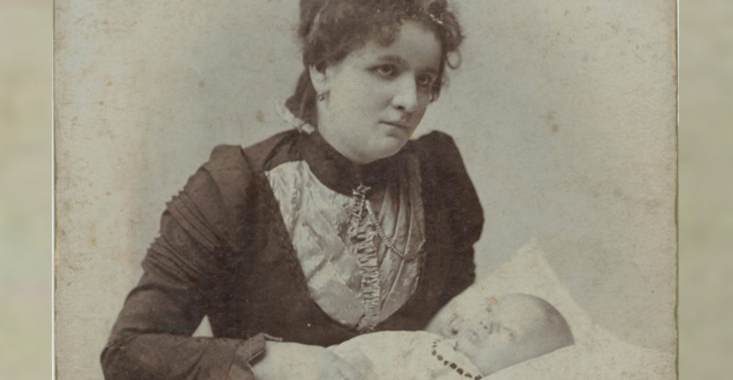
The haunting image of Otylia Januszewska holding her recently deceased son, Aleksander, captures not only profound grief but also the Victorian tradition of post-mortem photography. This practice, which became popular in the mid-19th century, served as a way to honor the deceased and preserve a final, tangible connection to loved ones—especially when the reality of death felt overwhelming.
Rooted in the concept of memento mori, meaning “remember you must die,” this idea has deep historical roots. During the Middle Ages, artwork often included reminders of death, and earlier cultures created objects depicting skeletons as a somber acknowledgment of life’s fragility.
With the rise of photography in the 19th century, people found a deeply personal way to preserve these memories. Families would photograph their deceased loved ones to hold onto them—keeping their faces forever within reach. It allowed the living not only to mourn but also to maintain a lasting emotional connection.
Interestingly, today we tend to focus on celebrating life after death, often avoiding direct confrontation with mortality. In contrast, Victorians openly embraced death, incorporating it into rituals that acknowledged its inevitability.
Post-mortem photography, which peaked in the 1860s and 1870s, began in the 1840s with the invention of photography. While not everyone was comfortable with it, the practice became widespread across the UK, the USA, and Europe.
9-year-old factory worker in Maine (1911)
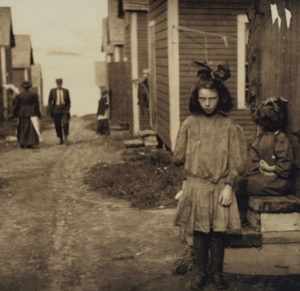
In 1911, life for many working-class families in America revolved around long hours and doing whatever it took to make ends meet.
For Nan de Gallant, a 9-year-old girl from Perry, Maine, summers meant working at the Seacoast Canning Co. in Eastport. Instead of playing with friends, she helped her family cart sardines, working long hours alongside her mother and two sisters.
Child labor was common in early 20th-century America, especially in industries like canning, textiles, and agriculture. For families, every extra pair of hands mattered—but for children like Nan, it meant sacrificing their childhood. By age 9, she was already working, which, sadly, wasn’t unusual at the time. According to the U.S. Bureau of Labor Statistics, 18% of children aged 10 to 15 were working in 1910.
In Maine, laws banned children under 12 from working in manufacturing—but made exceptions for canning industries. Although that law changed in 1911, it’s unclear how much it improved conditions for children like Nan.
James Brock pours acid in the pool (1964)
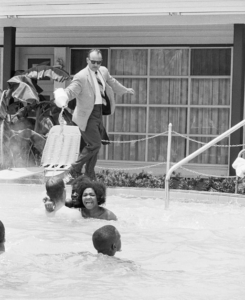
In 1964, a chilling photograph captured motel manager James Brock pouring muriatic acid into the Monson Motor Lodge pool to prevent Black swimmers from using it.
This act followed an attempt by Black activists to integrate the segregated space in St. Augustine, Florida. Rather than allow equality, Brock chose to destroy the pool.
The image, taken by Charles Moore, symbolizes the deep-rooted racism of the time and the courage of those fighting for civil rights. Today, it stands as a reminder of how far we’ve come—and how far we still have to go in the fight for equality. It speaks to resilience, resistance, and the importance of confronting uncomfortable truths in our history.
Coal miners returning from the depths (c. 1900)
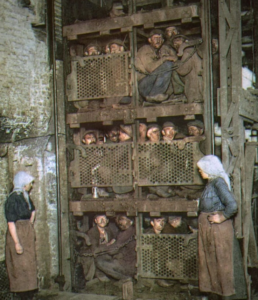
In the early 1920s, Belgian coal miners endured long, dangerous days underground, helping power the industrial revolution. After hours of exhausting labor in darkness, they would crowd into a tight elevator, finally heading back toward daylight. The creaking of the lift and the quiet murmur of their voices reflected how much they relied on one another.
Their faces, covered in coal dust, told stories of hardship and sacrifice. Every line and wrinkle showed the toll of their work, but also their pride. These men fueled industries that kept society moving—often at the cost of their own health and safety.
Stepping back into the light was a stark contrast to the darkness below—but it also symbolized their resilience. Bound by shared struggle, they supported each other and carried on. Their unity was the foundation of their community.
Alvin Karpis’s fingertips (1936)
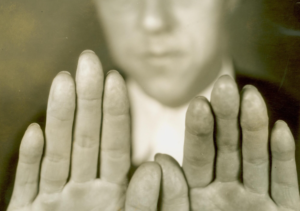
Alvin “Creepy” Karpis, a notorious criminal of the 1930s and member of the Barker gang, was involved in several high-profile kidnappings. After leaving fingerprints at crime scenes in 1933, he attempted to erase his identity.
In 1934, he and fellow gang member Fred Barker underwent cosmetic procedures performed by underworld doctor Joseph “Doc” Moran. Their noses, chins, and jaws were altered, and their fingertips were treated with cocaine and scraped in an attempt to remove fingerprints.
Despite these efforts, Karpis was captured in New Orleans in 1936, sentenced to life in prison, and spent over 30 years behind bars, including time at Alcatraz. He was eventually paroled in 1969.
Halloween costumes in 1930
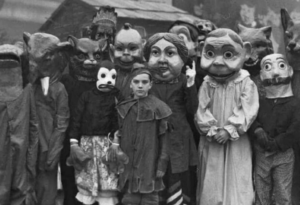
During the Great Depression, as vandalism and unrest increased, communities introduced traditions like handing out candy, hosting costume parties, and organizing haunted houses to discourage troublemaking. This period also brought a wider variety of costume choices for children, adding more fun and creativity to Halloween celebrations.
Two men making a death mask (c. 1908)
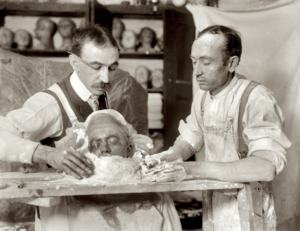
Death masks have long been used to preserve the likeness of the deceased. Ancient Egyptians created detailed masks to guide the dead in the afterlife, while Greeks and Romans made statues and busts of their ancestors.
What set death masks apart was their realism. Unlike idealized sculptures, they captured true facial features, serving as lasting tributes. Notable figures like Napoleon, Lincoln, and Washington had death masks made, which later helped artists create accurate statues and busts.
Is there an image you’ve missed—or one that stood out to you? What do you think of these eerie photographs? Which one left the strongest impression? Feel free to share your thoughts in the comments on Facebook!