On Sunday, February 8, 2026, Super Bowl LX at Levi’s Stadium delivered more than just a high‑stakes football game.
While the Seattle Seahawks decisively defeated the New England Patriots 29–13 with a combination of skill, strategy, and ferocious defensive play, much of the public’s attention quickly shifted to what happened off the field.
This year, the Super Bowl didn’t feature just one halftime show—it delivered two competing spectacles, each with its own audience, its own cultural narrative, and, ultimately, its own controversies.
The Seahawks’ Victory: A Football Masterclass Before diving into the halftime drama, it’s important to acknowledge the Seahawks’ performance. Seattle’s defense dominated from the outset, disrupting New England’s offensive plays and applying constant pressure on the quarterback. Key turnovers and strategic sacks punctuated the game, leaving the Patriots scrambling to maintain momentum.
Wide receivers, tight ends, and defensive backs all contributed to a disciplined game plan that showcased Seattle’s athletic excellence.
Yet despite the significance of the game itself, the broader media conversation soon shifted away from football and toward cultural spectacle, political commentary, and performance art.
Enter the “All‑American Halftime Show” While the NFL’s official halftime spotlight belonged to global sensation Bad Bunny, millions of viewers had the option of tuning into Turning Point USA’s rival “All‑American Halftime Show.”
The organization—founded as a conservative nonprofit in 2012 by the late Charlie Kirk—promoted this alternative event as a cultural counterpoint to the NFL’s mainstage production.
The show featured several high‑profile country and rock performers, including Brantley Gilbert, Lee Brice, Gabby Barrett, and, ultimately, Kid Rock.
This alternative broadcast aimed to offer a politically conservative perspective on American culture, music, and entertainment.
Billed as a celebration of traditional American values and small‑town sensibilities, the event was marketed toward viewers seeking a contrast to what TPUSA framed as “the mainstream, liberal, and politically charged” Super Bowl halftime narrative.
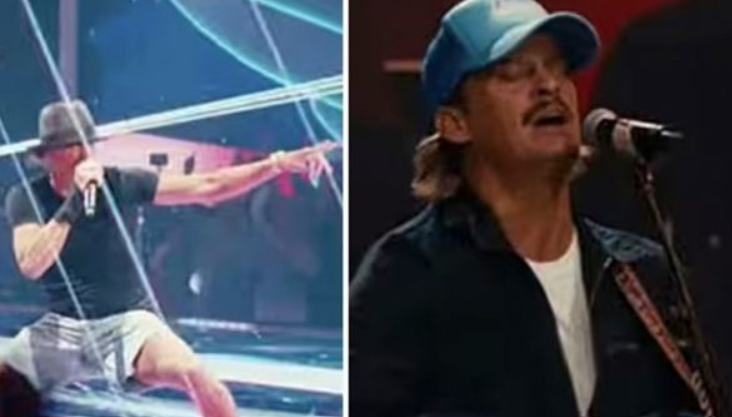
Kid Rock’s Headlining Performance At 55, Kid Rock took the stage to close out the TPUSA broadcast, following performances from Brantley Gilbert, Lee Brice, and Gabby Barrett.
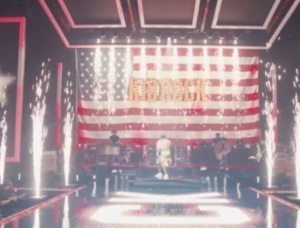
Anticipation was high, with many expecting a full‑length set matching his reputation for high‑energy rock‑rap fusion. But within moments, audience reactions suggested the performance might not meet expectations.
Lip‑Sync Accusations Almost immediately, viewers began accusing Kid Rock of lip‑syncing. Comments flooded social media and the broadcast’s live chat, with many noting inconsistencies between his vocals and movements. Sample reactions included:
“Nice lip syncing.” “Did Kid Rock just badly lip sync through his song? Or was my stream messed up?” “So was that a bad lip sync job by Kid Rock? Or was my stream messed up? Thank you for your attention to this matter.”
Others were more blunt:
“Did Kid Rock do like a minute of lip sync and dip, LOL?” “It was a minute of lip sync and then he dipped.” “Bruh, I thought I was gonna see Kid Rock come and slay. He didn’t do anything but play his song and do a funny dance.” “Kid Rock came out for 45 seconds to lip sync and drop the mic five times while he was still ‘singing.’”
One viewer mocked the moment in detail: “Kid Rock showed up for one minute and lip‑synced every third bar from the first verse of ‘Bawitdaba’ while tweaking in jorts and playing with his fedora, then it awkwardly cut to a classical performance.”
The comments reflected widespread frustration and disappointment among viewers who had expected a longer, more dynamic performance.
Controversy Surrounding Kid Rock’s Past Lyrics The criticism didn’t end with alleged lip‑syncing. As the broadcast aired, older lyrics from Kid Rock’s 2001 track Cool, Daddy Cool resurfaced online.
One line in particular sparked outrage: “Young ladies, young ladies, I like ’em underage. See, some say that’s statutory. But I say it’s mandatory.”
Clips from a 2001 Saturday Night Live appearance also began circulating, where he joked about Mary‑Kate and Ashley Olsen—then 14 years old: “Why is every guy in America waiting on these chicks to turn 18? … I mean—you know what I say—if there’s grass on the field, play ball.”
These resurfaced statements fueled backlash and renewed criticism of Kid Rock, with some calling him “disgusting,” while others defended the performance as entertainment separate from past lyrics.
Support and Mixed Reactions Not all reactions were negative. Some fans appreciated the nostalgia, especially the return of classic tracks like Bawitdaba. Supporters wrote:
“Kid Rock busted out ‘Bawitdaba.’ Unbelievable and totally awesome!” “TPUSA halftime performance was worth it. History was made tonight, my friends. Love you, Charlie.”
Despite mixed opinions, the livestream peaked at around 5 million viewers before dipping slightly during Kid Rock’s set.
At the time of writing, the YouTube stream of the TPUSA All‑American Halftime Show had surpassed 18 million views, highlighting the significant public interest in the alternative broadcast.
The Broader Context: TPUSA’s Cultural Positioning Turning Point USA’s decision to host an alternative halftime show reflects broader trends in American media and politics.
The organization positioned the broadcast as a counter‑narrative to the NFL’s mainstage production, emphasizing conservative ideals and traditional cultural themes.
By featuring country and rock artists, TPUSA aimed to appeal to viewers seeking entertainment aligned with their values. The event illustrates how major cultural spectacles like the Super Bowl have become arenas not just for entertainment but also for ideological expression.
In an era of polarized media consumption, alternative broadcasts allow organizations to capture niche audiences and offer content tailored to specific cultural or political perspectives.
The Role of Social Media Social media played a major role in shaping public perception of the TPUSA halftime show. Platforms like Twitter, YouTube, and TikTok enabled real‑time commentary, debate, and the viral spread of clips from Kid Rock’s performance.
Criticism of lip‑syncing, jokes about the brief stage time, and debates over past lyrics circulated rapidly, showing how quickly public opinion can form and amplify online.
Supporters used social media to celebrate the event, while detractors used it to express disapproval and contextualize Kid Rock’s performance within broader discussions about music, ethics, and politics.
Music, Politics, and Public Perception The controversy surrounding Kid Rock’s performance highlights the intersection of music, politics, and public morality.
While his past lyrics drew scrutiny, the event itself was framed as a celebration of traditional American values, appealing to audiences aligned with conservative perspectives.
This duality underscores the complex relationship between an artist’s history, their public persona, and the ideological lens through which their work is viewed.
The TPUSA broadcast also shows how live performances can become symbolic touchpoints in political discourse.
Implications for Future Halftime Shows The success and controversy of the TPUSA All‑American Halftime Show may influence future alternative broadcasts. Key takeaways include:
- Audience Segmentation: Multiple broadcasts allow the Super Bowl to cater to diverse cultural and political perspectives.
- Real‑Time Engagement: Social media ensures every moment is scrutinized instantly.
- Performer Accountability: Past statements can resurface and shape public perception.
- Alternative Platforms: Niche media outlets can reach massive audiences during major events.
Conclusion Super Bowl LX showed that the spectacle of America’s most‑watched sporting event extends far beyond the field.
While the Seattle Seahawks delivered a decisive victory over the New England Patriots, the off‑field narratives surrounding the halftime shows—both the NFL’s mainstage performance with Bad Bunny and the TPUSA All‑American Halftime Show—captured global attention.
Kid Rock’s controversial performance, marked by accusations of lip‑syncing, brief stage time, and renewed scrutiny of past lyrics, became a focal point for both criticism and praise.
The livestream drew millions of viewers and sparked widespread discussion about music, politics, and public morality in contemporary entertainment.
Ultimately, the TPUSA halftime show highlights the evolving cultural landscape of live events.
In a polarized media environment, alternative broadcasts can generate massive engagement, serve as ideological counterpoints, and ignite debates that extend far beyond the performance itself. Super Bowl LX, therefore, will be remembered not only for the Seahawks’ dominance on the gridiron but also for the complex interplay of music, politics, and public perception that unfolded during the TPUSA All‑American Halftime Show.