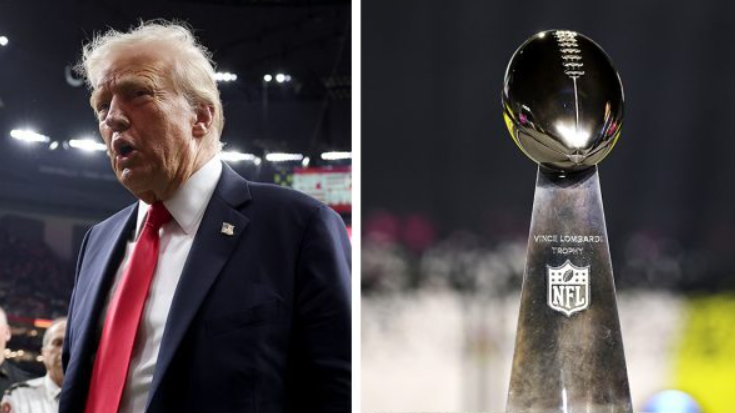
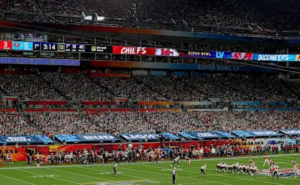
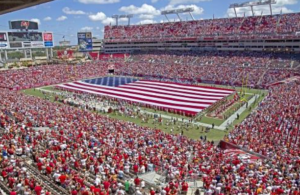
Tens of thousands of fans have gathered at Levi’s Stadium in Santa Clara, California, for Super Bowl LX, one of the most widely anticipated sporting events in the United States and arguably the world.
Every year, the Super Bowl draws not only football enthusiasts but also celebrities, political figures, and a global television audience, making it a unique intersection of sports, entertainment, and culture.
Yet despite the high stakes and massive fanfare, one prominent figure is notably absent this year: President Donald J. Trump.
His absence has sparked discussion among sports analysts, political commentators, and fans alike, particularly because last year, Trump made history by becoming the first sitting president to attend a Super Bowl. That event took place in New Orleans, where he watched the Philadelphia Eagles face the Kansas City Chiefs, marking a significant moment in presidential engagement with American sports culture.
Trump’s Explanation for Skipping the Event
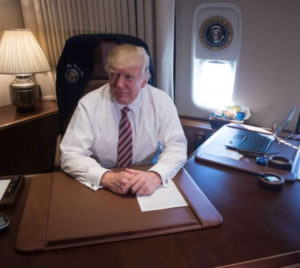
Well ahead of this year’s game, Trump publicly explained his reason for skipping the event, citing logistical concerns. In an interview with the New York Post, he said: “It’s just too far away. I would go if, you know, it was a little bit shorter.”
The travel distance from Washington, D.C., to Santa Clara, California, is roughly 2,700 miles, translating to a five‑ to six‑hour flight depending on weather and air traffic.
For a sitting or former president, such a trip requires extensive logistical planning, security coordination, and time allocation, making it understandable that Trump cited the journey as a deterrent.
However, seasoned political analysts have noted that while the distance is a legitimate factor, it likely isn’t the only reason for Trump’s absence.
Context suggests the decision may also be influenced by the high‑profile artists scheduled to perform at the game—some of whom Trump has publicly criticized.
Trump’s Disapproval of the Super Bowl Lineup
This year’s Super Bowl LX features two major musical acts:
- Green Day, who performed during the opening ceremony
- Bad Bunny, the internationally acclaimed Puerto Rican performer who headlined the halftime show
Trump has made his opposition to both artists clear. Speaking candidly, he said: “I’m anti‑them. I think it’s a terrible choice. All it does is sow hatred. Terrible.” These comments reflect not only personal distaste but also a broader cultural critique. Both performers have been associated with messaging that Trump and his supporters view as politically charged or socially provocative.
Green Day and Their Political Overtones
Green Day, a California‑based punk‑rock band, is known for politically infused music. Over the past two decades, they have repeatedly used their platform to critique political institutions, including the U.S. presidency, wars, and social inequality.
Their 2004 hit “American Idiot” was widely interpreted as commentary on the George W. Bush administration and U.S. political culture.
For Super Bowl LX, Green Day delivered a high‑energy opening ceremony performance. While fans praised the musicality and production, Trump’s remarks suggest he viewed the choice as divisive for an event meant to unite a national audience.
Bad Bunny: International Superstar and Cultural Icon
The halftime show, always one of the most‑watched segments of the Super Bowl, featured Bad Bunny, a Puerto Rican singer, rapper, and cultural figure.
Known for blending reggaeton, Latin trap, and pop, Bad Bunny has achieved global recognition, selling out arenas and topping streaming charts.
He has also incorporated social and political commentary into his work. Notably, he refused to perform in the U.S. last year over concerns that ICE could conduct raids at his concerts, sparking discussion about immigration and civil rights.
Despite past controversies, Bad Bunny accepted the Super Bowl invitation, framing it as a celebration of Puerto Rican culture and heritage.
He said: “What I’m feeling goes beyond myself, it’s for those who came before me and ran countless yards so I could come in and score a touchdown. This is for my people, my culture and our history.”
This sentiment underscores the cultural significance of his performance and may help explain Trump’s dissatisfaction with his participation.
For Trump, the combination of Green Day’s politically charged set and Bad Bunny’s culturally specific halftime show likely contributed to his decision to skip the event.
Travel Considerations for High‑Profile Attendees
While cultural and political factors likely played a role, practical travel logistics cannot be ignored. A round trip from Washington, D.C., to Santa Clara requires coordination with Air Force One or equivalent security arrangements, along with advance teams to manage crowd security, motorcades, and communications.
A five‑ to six‑hour flight does not account for pre‑departure planning, press coverage, or post‑event obligations. For a former president with ongoing commitments, such a trip represents a significant investment of time and resources.
Trump framed the distance as a factor, saying it was simply “too far away,” an explanation consistent with the realities of long‑haul travel for high‑profile figures.
Yet when considered alongside his public criticism of the performers, it becomes clear that multiple factors influenced the decision.
Public and Media Reactions
Trump’s absence from Super Bowl LX was widely noted by sports and political media. Social media users, commentators, and news outlets debated whether his absence was a political statement, a logistical choice, or both.
Some observers pointed out the irony, noting that attendance at major sporting events has historically been used as a gesture of public engagement for presidents.
Last year, his presence at the Super Bowl in New Orleans was widely covered and marked a historic first.
Supporters argued that his decision was practical, emphasizing travel time and personal priorities. Others speculated that his disapproval of the musical lineup may have been the more decisive factor.
The Broader Cultural Implications
The Super Bowl is more than a football game—it is a cultural touchstone reflecting broader societal trends, artistic innovation, and national identity. Halftime performances are scrutinized globally for their musical impact, political messaging, and inclusivity.
Trump’s criticism of Green Day and Bad Bunny aligns with a broader debate about the Super Bowl as a platform: Should it prioritize mainstream American cultural values, or serve as a global stage for diverse artistic expression?
His absence, paired with pointed criticism, places him at the center of this ongoing conversation.
Bad Bunny’s Perspective and Cultural Significance
Bad Bunny’s decision to perform at Super Bowl LX, despite previous concerns about ICE, demonstrates artistic courage and cultural pride.
By highlighting Puerto Rican history and heritage, he framed his performance as more than entertainment—it was a celebration of identity and representation.
For many fans, his message was a reminder of how music can bridge communities and cultures on one of the world’s largest stages.
Concluding Thoughts
Donald Trump’s absence from Super Bowl LX highlights the intersection of politics, culture, and personal choice. While travel logistics played a role, his public disapproval of Green Day and Bad Bunny adds deeper context.
Super Bowl LX at Levi’s Stadium remains a focal point for athletic and cultural discussion. The game, halftime show, and surrounding commentary illustrate how sports events can transcend the field, becoming platforms for broader societal conversations.
Whether Trump’s decision will influence future political engagement with major sporting events remains to be seen, but it underscores how the Super Bowl is as much about cultural symbolism as it is about football.
By choosing to skip the event, Trump has added his own chapter to the ongoing story of how politics, entertainment, and public perception converge at one of America’s most watched annual spectacles.