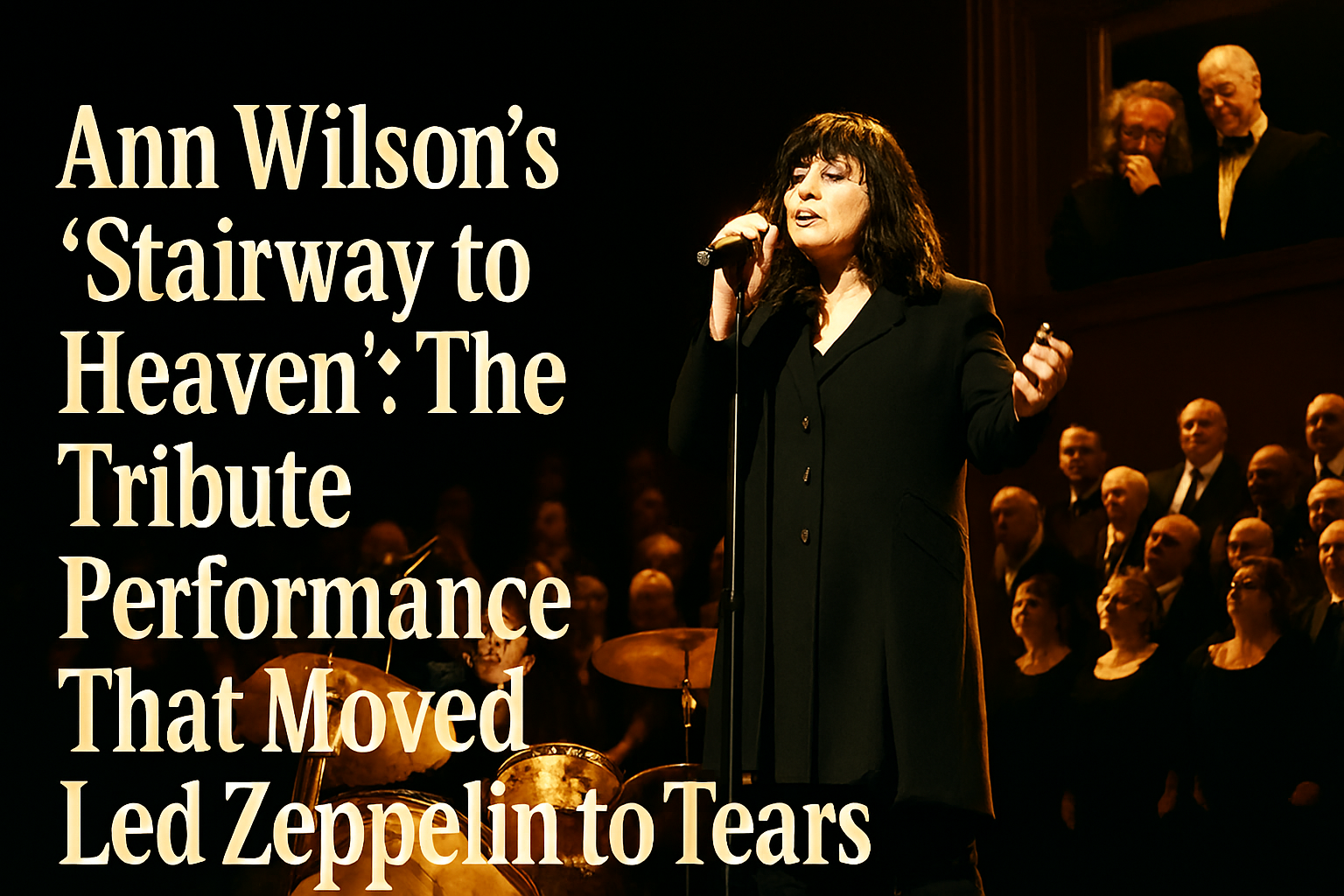
Ann Wilson’s Kennedy Center performance of “Stairway to Heaven” is remembered as a once-in-a-lifetime musical moment that moved Led Zeppelin to tears and redefined what a tribute can be.
A Night Framed by Ceremony
The setting could not have been more fitting: the Kennedy Center Opera House, an ornate hall built for moments of national significance, filled to capacity with an audience that included the very artists being honored. The occasion carried a formal weight, but what unfolded on stage transcended ceremony. From the first note, the performance felt less like a cover and more like a consecration—an offering from one generation of rock royalty to another.
Commanding Presence and Vocal Mastery
Ann Wilson stepped into the spotlight with the kind of authority that only decades of artistry can produce. Her voice, at once powerful and nuanced, navigated the song’s delicate opening and its eventual, thunderous climax with absolute control. She shaped each phrase with intention, balancing technical precision and emotional depth. The arrangement allowed her to reveal the song’s intimacy before unleashing its full dramatic force, and she did so with a mastery that left no doubt she was in command of both stage and instrument.
The Surprise of the Chorus
One of the most striking elements of the tribute was the unexpected addition of a full chorus. What began as a solitary vocal statement gradually swelled into a communal sound, the choir’s harmonies lifting the arrangement into a near-sacred space. The chorus didn’t merely add volume; it reframed the song, turning a familiar studio recording into a shared, almost liturgical experience. That surprise element amplified the emotional stakes and made the performance feel larger than any single artist could achieve alone.
A Family Connection: Jason Bonham’s Return
The tribute’s emotional resonance deepened when Jason Bonham took his place behind the drum kit. His presence was more than a technical contribution; it was a living link to the original band. As he played, the performance gained a layer of personal history—an acknowledgment of legacy that made the moment feel intimate and profoundly respectful. The drums anchored the climactic surge, giving the arrangement a heartbeat that connected past and present in a single, powerful pulse.
The Audience Reaction
The Kennedy Center audience, which included Robert Plant, Jimmy Page, and John Paul Jones, responded in a way that confirmed the performance’s extraordinary nature. Eyes turned to the balcony where the members of Led Zeppelin sat, and the sight of those icons moved by the music was itself a part of the evening’s drama. As the arrangement reached its peak, Robert Plant was visibly affected—overcome by the magnitude of what he was hearing. The collective reaction in the hall—gasps, tears, and stunned silence—made clear that everyone present recognized they were witnessing something rare.
Why the Performance Endures
Several factors explain why this rendition continues to resonate. First, there was the technical excellence: Ann Wilson’s vocal control, the choir’s precision, and Jason Bonham’s sympathetic drumming combined to create an impeccably executed performance. Second, the arrangement honored the original while adding new textures that deepened the song’s emotional impact. Finally, the authenticity of the moment—artists paying tribute to peers with sincerity rather than spectacle—gave the performance moral and artistic weight. When craft and feeling align so perfectly, the result is unforgettable.
A Tribute That Rewrote Expectations
Tributes can be uneven affairs, sometimes leaning too heavily on nostalgia or spectacle. This performance did neither. Instead, it rewrote expectations for what a tribute can be: not a mere reenactment, but a reimagining that honors the source material while offering something new. It demonstrated that a cover can be an act of reverence and creativity at once, capable of moving even the original creators to tears.
The Lasting Image
Years later, the image of Ann Wilson standing center stage—voice soaring, choir behind her, Jason Bonham driving the rhythm, and Led Zeppelin watching from the balcony—remains seared into the memories of those who were there. It is a snapshot of music’s power to bridge generations, to transform admiration into art, and to create a shared moment that outlives the event itself.
Conclusion: A Moment of Musical Communion
This will be remembered as one of the great performances in rock history not because it was flawless—though it was—but because it achieved something rarer: it created communion. Ann Wilson’s rendition of “Stairway to Heaven” at the Kennedy Center was a tribute that honored a legacy, celebrated a lineage, and moved the very people it honored. In doing so, it became more than a performance; it became a testament to the enduring, communal power of music.