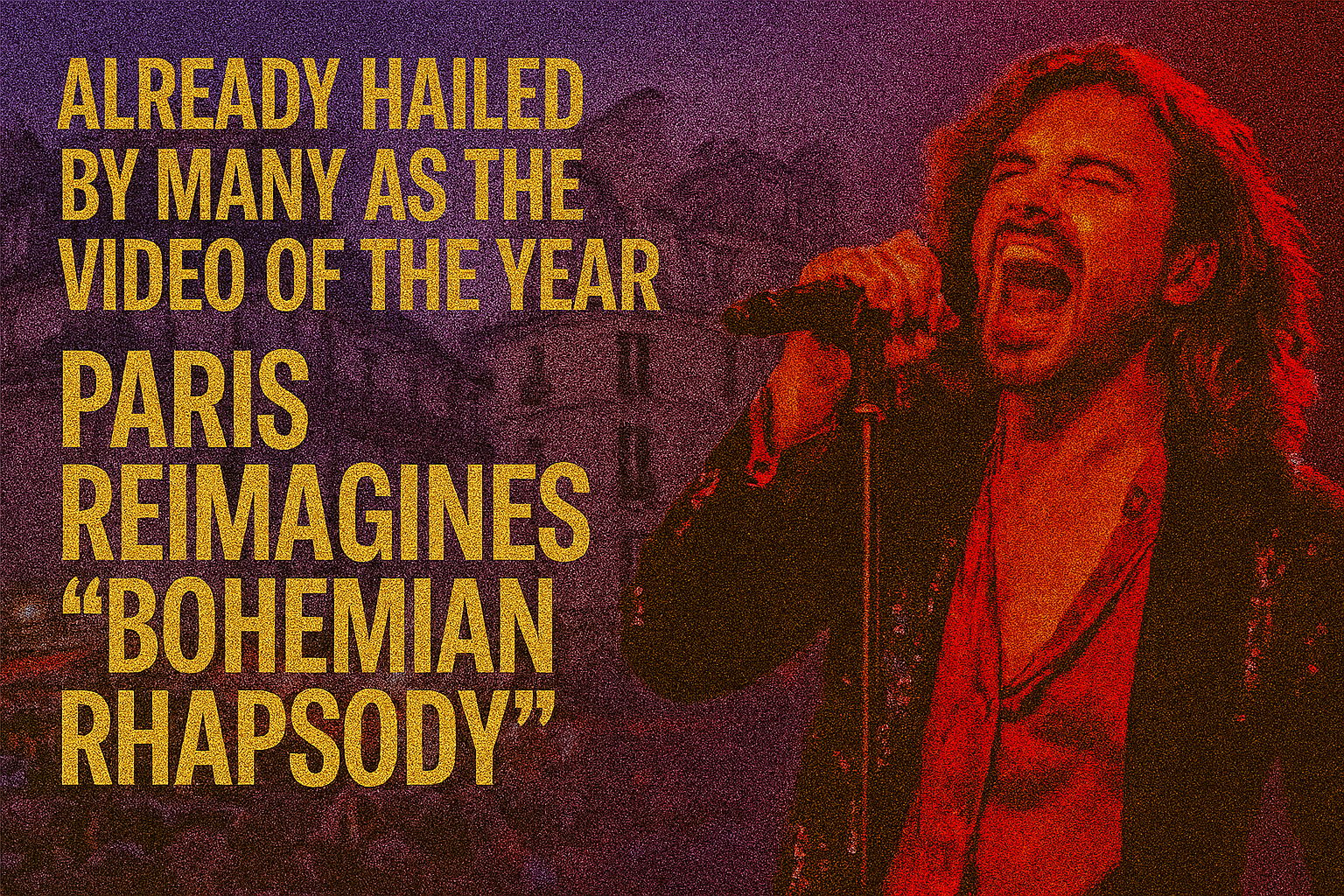
On a summer evening in Paris, a flash mob performance of Queen’s “Bohemian Rhapsody” erupted in the Place de la Contrescarpe—and within days, it was being hailed as the video of the year. With over 22 million views and counting, this nine-minute spectacle has captivated audiences worldwide, blending cinematic ambition with raw street-level magic.
A Street Transformed into a Stage
The performance begins quietly. Pedestrians stroll, diners sip wine, and the city hums with its usual rhythm. Then, from a window above the square, three women—Anouche, Stella, and Nounée—begin singing the iconic opening lines: “Is this the real life? Is this just fantasy?” Their harmonies float over the cobblestones, freezing the moment in time.
Pianist Julien Cohen, the mastermind behind the event, emerges with a Shigeru Kawai piano and begins the haunting intro. As the crowd gathers, lead singer Mickey Callisto steps forward in a sequined blazer and red satin shirt, channeling Freddie Mercury with theatrical flair and emotional intensity. His voice is not an imitation—it’s a reinterpretation, full of grit, vulnerability, and fire.
A Cast of Virtuosos
This wasn’t a casual jam session. It was a meticulously orchestrated ensemble of over 30 musicians and singers. Guitarists Olly Pearson and Axel Thomas delivered blistering solos. Bassist Paul Pasmanian and drummer Martin Pennec anchored the rhythm section with precision. A child prodigy even stepped in to perform the legendary guitar solo, adding a layer of wonder to the already surreal scene.
Backing vocals came from a pop choir and an opera ensemble, including Eeva Suvanto, Sara Paone, Lisa Chaïb-Auriol, Olga Vojnovic, Dounia El Baaj, and Shadi. Their harmonies turned the street into a cathedral of sound, elevating the performance from flashmob to full-blown rock opera.
A Cinematic Journey Through Queen’s Masterpiece
“Bohemian Rhapsody” is more than a song—it’s a journey. And this performance honored every twist and turn. From the operatic crescendo to the head-banging rock finale, the flash mob captured the emotional arc with stunning fidelity.
The operatic section—“Galileo! Figaro! Magnifico!”—was a theatrical explosion. Singers popped out of windows, stepped from cars, and emerged from alleyways. The crowd became part of the chorus, singing, clapping, and cheering. It was communal, cathartic, and unforgettable.
Viral Impact and Critical Acclaim
Within hours of its release on Julien Cohen’s YouTube channel, the video went viral. Critics called it “lightning in a bottle” and “the most ambitious Queen tribute ever recorded.” Fans flooded social media with praise, reaction videos, and emotional testimonials.
Ultimate Classic Rock described it as “a full-blown opera detonating into rock chaos.” The Music Man called it “the greatest Bohemian Rhapsody tribute you’ll ever see.” Consequence noted the video had surpassed 500,000 views in its first day.
Why It Resonates
The performance’s success isn’t just about musical talent—it’s about emotional authenticity. It captures the spirit of Queen while offering something new. It reminds viewers that music, when performed with heart and precision, can still stop time.
“Bohemian Rhapsody” is a song about guilt, redemption, and existential wonder. In the hands of this Parisian ensemble, it became a living, breathing experience. It wasn’t just a tribute—it was a transformation.
The Man Behind the Magic
Julien Cohen, the pianist and organizer, spent months planning the event. He recruited talent, secured permits, and footed the €50,000 bill himself. His vision was clear: to create a moment of musical transcendence in the heart of Paris. And he succeeded.
Cohen’s dedication to live performance and community art has made him a rising figure in the global music scene. His next project? A 100-piece classical ensemble performing Imagine Dragons’ “Believer” on a Paris boulevard. If the “Bohemian Rhapsody” flashmob is any indication, it’s bound to be unforgettable.
A Tribute That Transcends
This flashmob wasn’t just a tribute to Queen—it was a tribute to the power of music itself. It showed that even in a digital age, live performance can still astonish. It proved that cities still have soul. And it reminded us that sometimes, in the middle of an ordinary day, a piano and a song can turn strangers into a symphony.
As the final line rang out—“Nothing really matters to me…”—the crowd stood silent. Then came the applause. The hugs. The tears. The laughter. The street, once ordinary, had become sacred.