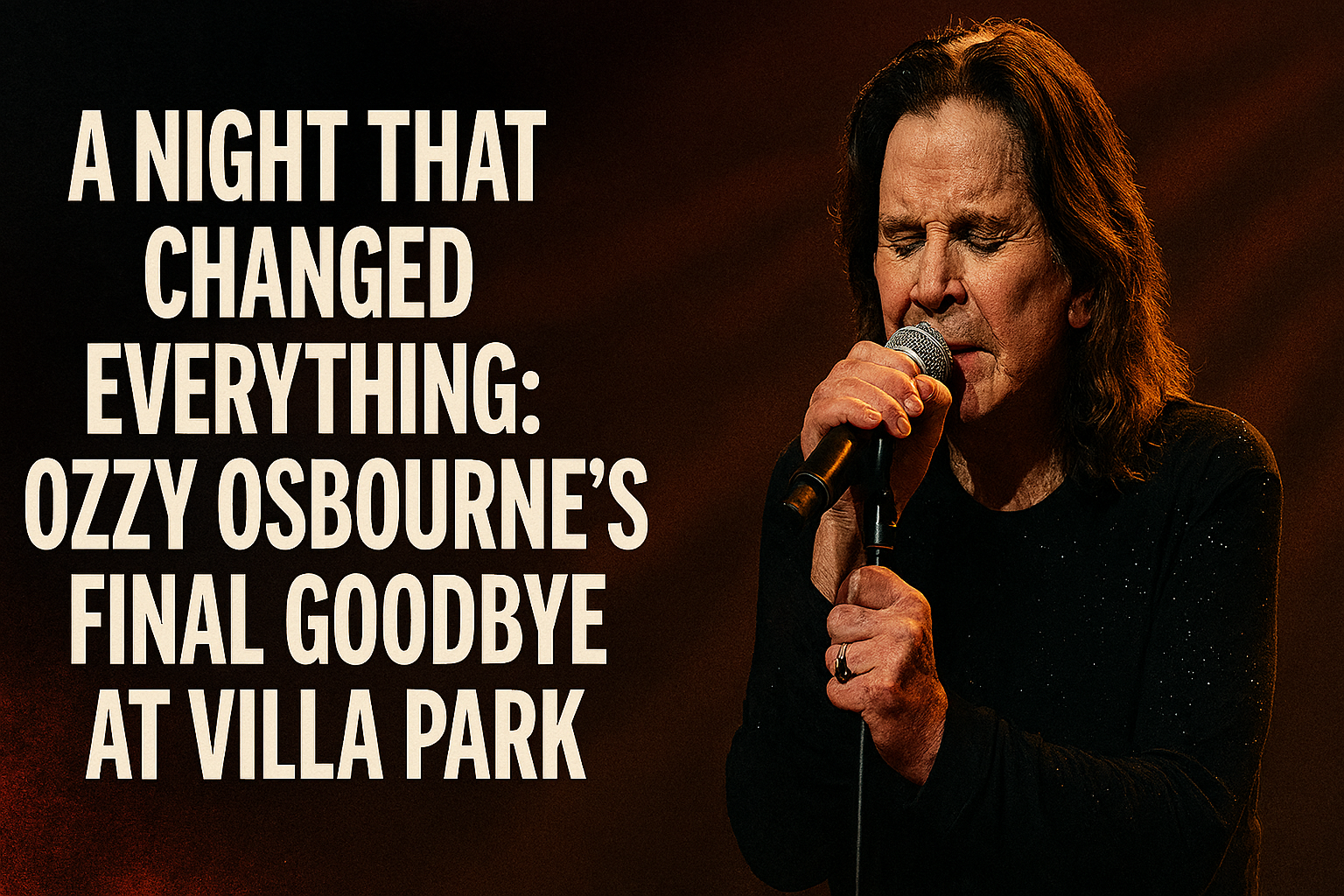
There are concerts, there are farewells, and then there are nights that feel like the closing of a chapter in music history. Ozzy Osbourne’s final goodbye at Villa Park was exactly that — a moment suspended in time, where decades of chaos, triumph, pain, and resilience converged into one last roar from the Prince of Darkness. For fans who had followed him through every era, every reinvention, and every storm, this wasn’t just a performance. It was the end of a lifetime lived on the edge of a stage.
Villa Park had seen its share of unforgettable nights, but nothing prepared the stadium for the emotional weight that settled over it as the lights dimmed. The air felt charged, almost reverent, as if the entire venue understood the gravity of what was about to unfold. This wasn’t a comeback. This wasn’t a surprise appearance. This was Ozzy Osbourne — the man who defined heavy metal’s wild heart — stepping into the spotlight for the last time.
From the moment he appeared, the crowd erupted with a mixture of joy and heartbreak. Ozzy didn’t walk onto that stage as a fading legend. He walked out as a warrior who had survived everything: addiction, illness, fame, controversy, and the relentless grind of the road. His presence alone was a reminder of why he mattered — why he still matters. Even before he sang a note, the night already felt historic.
The opening chords rang out, and the stadium transformed. Fans who had grown up with Black Sabbath, who had blasted “Crazy Train” from their first car, who had clung to “Mama, I’m Coming Home” during their darkest moments — they all felt the same thing. This wasn’t just music. It was memory. It was identity. It was the soundtrack of generations echoing through the stands.
What made the night even more powerful was the vulnerability woven into every moment. Ozzy’s voice carried the weight of years, but it also carried a clarity that only comes from someone who has lived every lyric. When he sang, it wasn’t polished — it was honest. Raw. Human. And that honesty made the performance feel even more intimate, even in a stadium filled with thousands.
The production itself was cinematic. Lights washed the stage in deep blues and burning reds, colors that mirrored the emotional push and pull of the night. Screens displayed archival footage — young Ozzy, wild Ozzy, triumphant Ozzy — reminding everyone of the journey that had led to this final chapter. It wasn’t nostalgia for the sake of nostalgia. It was a tribute to a life lived loudly, unapologetically, and without restraint.
But the moment that broke the stadium came near the end.
As the opening notes of “Mama, I’m Coming Home” filled the air, a hush fell over the crowd. It was the song that had always felt like a confession, a plea, a promise. And on this night, it became something more — a farewell letter. Ozzy’s voice trembled, not from weakness, but from emotion. Fans sang with him, thousands of voices rising into the night, creating a chorus that felt like a final embrace.
The camera angle that captured nearly the entire stadium — the one that later went viral — showed the magnitude of the moment. A sea of lights. A legend at the center. A lifetime closing in real time. It didn’t feel like watching a performance. It felt like witnessing history.
When Ozzy reached the line that echoed through the stadium — the plea not to be forgotten — it hit differently. It wasn’t theatrical. It wasn’t scripted. It was a man who had given everything to his fans asking them to hold onto the memory of who he was, not just the myth he became. And they did. They always will.
As the final notes faded, Ozzy raised his hand in a gesture that was part salute, part goodbye, part thank‑you. The crowd roared, not in celebration, but in gratitude. Gratitude for the music. Gratitude for the madness. Gratitude for the decades of moments that shaped their lives.
He didn’t leave the stage as a broken man. He left as a legend who had earned his rest.
The walk backstage — slow, steady, illuminated by the glow of thousands of phone lights — felt symbolic. It was the closing of a door. The end of an era. The final step of a journey that began in Birmingham and ended in a stadium filled with people who loved him not despite his flaws, but because of them.
Ozzy Osbourne’s final goodbye at Villa Park wasn’t just a concert. It was a reminder of why music matters — why artists like Ozzy become more than performers. They become anchors. They become memories. They become part of who we are.
And on that night, under the lights of Villa Park, Ozzy didn’t just say goodbye.
He changed everything.