On the night of January 31, 2026, a quiet suburban community in the Catalina Foothills just outside Tucson, Arizona, became the center of a heartbreaking and now internationally followed missing‑person case.
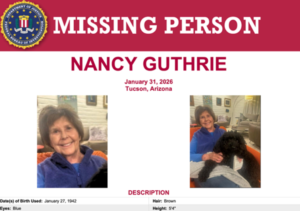
Nancy Guthrie, an 84‑year‑old grandmother and long‑time Tucson resident, vanished from her home under circumstances that have left investigators, family, and the public desperate for answers.
Nancy was widely known in her community as a generous neighbor and devoted mother. But her disappearance has now made her name internationally recognizable — not only because of who her daughter is, but because of the disturbing clues left behind and the profound mystery surrounding her fate.
An Ordinary Evening Turns Into a Nightmare
Friends and family describe Nancy’s last evening as completely ordinary — a reminder of how unpredictably tragedy can strike. On the night of January 31, she spent time with her daughter Annie and other family members, sharing dinner, laughter, and conversation that felt like any typical family gathering.

According to the official timeline released by law enforcement, Nancy was dropped off at her home around 9:48 p.m. by her son‑in‑law, Tommaso Cioni.
She appeared well‑oriented and in good spirits — a woman described by loved ones as mentally sharp, socially active, and independent despite her age.
There were no signs of conflict, distress, or any intention to leave her home. She lived alone, as she had for decades, and maintained close, supportive relationships with all her children.
That normalcy is now one of the most haunting elements of the case: a woman enjoyed a routine evening with family, and just hours later, her absence would trigger a desperate search.
The Alarming Discovery: A Crime Scene Emerges
Nancy was expected to attend a scheduled virtual church service the next morning. When she didn’t show up or answer calls, a church friend alerted her family.

Around 11:00 a.m. on February 1, relatives arrived at her home and immediately sensed something was wrong. Nancy was gone, and her personal belongings — including her phone, medications, and everyday items — were still inside.
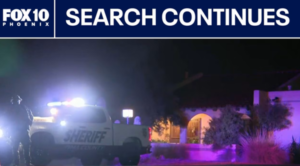
Local deputies from the Pima County Sheriff’s Department responded, and over the next several hours, the scene began to reveal disturbing clues:
Evidence of Force or a Struggle: Investigators found physical signs suggesting someone had entered or exited the home against Nancy’s will.
The front doorbell camera — a Ring device — had been forcibly disconnected and torn from its housing.
Security System Disruption: The doorbell’s footage did not capture the critical moments, leading investigators to believe the disconnection was intentional and premeditated.
Officers also noted unusual internet outages reported by neighbors that night, which are being reviewed to determine whether they indicate interference with digital devices.
Digital Evidence Goes Dark: Motion was detected on the home’s security system around 1:47 a.m., followed by the disconnection of Nancy’s pacemaker app from her phone around 2:28 a.m.
This sudden loss of telemetry raised immediate alarm, suggesting she may have been taken while she slept.
At an early press conference, Pima County Sheriff Chris Nanos confirmed that detectives were treating the residence as a crime scene, not a simple missing‑person case. “We do not see this as much as a search mission as a crime scene,” he told reporters, signaling strong suspicion of foul play.

The Search Expands: FBI and Local Law Enforcement Join Forces
As hours turned into days, the investigation widened. Local police continued canvassing and forensic work, while the FBI brought additional expertise in kidnapping and digital evidence analysis.
Investigators interviewed neighbors, utility workers, and anyone who might have been in the area that night.
Extensive searches of properties, digital networks, and surveillance footage — from neighboring cameras, delivery vehicles, and traffic systems — were launched in hopes of identifying any person or vehicle of interest.
One lead that drew particular attention involved reports of internet outages in the neighborhood around the time of the disappearance.
Detectives questioned residents about disruptions to Wi‑Fi or broadband connections, though it remains unclear whether these issues were related to device interference or coincidental network problems.
Despite the advanced investigative resources deployed, no credible suspect had been publicly identified by early March 2026.
DNA samples collected from the scene were partial and complex, complicating efforts to match them to any individual in criminal databases.
A Family’s Agony: Public Pleas and Personal Silence
Nancy’s disappearance quickly shifted from a local alert to a national media storm — not only because of who her daughter is, but because of how little was known despite clear evidence and professional investigative work.
Savannah Guthrie, a veteran broadcast journalist and co‑anchor of NBC’s Today show, stepped away from her duties to be with her family and assist in the search.
She addressed the public in a heartfelt video plea, urging anyone with information to come forward and emphasizing the family’s love and hope for their mother’s safe return.
In her statements, Savannah balanced raw emotion with dignity, appealing not just to the person responsible but to anyone who might hold a crucial piece of information: “If you have information about our mother, please share it,” she said. “It is never too late to do the right thing.”
As weeks passed without a confirmed lead, the family increased pressure by offering a $1 million reward for any tip leading to Nancy’s safe recovery. Part of the reward was also donated to the National Center for Missing & Exploited Children, demonstrating their commitment to helping other families even amid their own heartbreak.
Despite her personal turmoil, Savannah made periodic public appearances — including an emotional visit to her Today show colleagues in early March — expressing her intention to eventually return to the anchor desk while continuing to advocate for her mother.
Investigative Challenges and Complex Leads
The Guthrie case has faced numerous investigative hurdles:
DNA and Forensics: Partial DNA traces found at the home proved difficult to interpret, and some early physical evidence — such as gloves found nearby — were ultimately traced to unrelated sources.
Ransom Claims: At various points, unverified ransom communications circulated on social media.
Officials and the family have not confirmed that any ransom demand was legitimately tied to the investigation, and law enforcement has warned against assuming authenticity.
Suspect Considerations: Authorities clarified that immediate family members, including Nancy’s children and their spouses, had been cleared as suspects, affirming their status as victims rather than persons of interest.
Internet and Digital Footprint: Investigators continue analyzing digital “breadcrumbs,” including cell‑tower data, neighborhood video systems, and network activity from the night of the disappearance.
These efforts highlight how modern forensic work blends physical and electronic evidence to reconstruct events.
Public and Social Impact
Nancy Guthrie’s disappearance has resonated widely. Because of Savannah’s public profile, the case received immediate national attention, but it has also sparked broader conversations:
Elder Safety: Experts have emphasized the vulnerabilities of elderly individuals living alone and the importance of secure social connections and emergency planning.
Smart Home Technology Limitations: The disabling of the doorbell camera has raised questions about the reliability of consumer security devices and whether they create a false sense of safety.
Media Attention Disparities: Some commentators have noted how this case contrasts with less‑covered disappearances in other communities, raising questions about equity in missing‑person reporting.
The Human Cost: Ambiguous Loss
For Nancy’s family, the psychological toll is immense. Experts describe the experience of having a loved one disappear without resolution as “ambiguous loss” — a form of grief without closure that makes emotional processing extraordinarily difficult.
The uncertainty surrounding Nancy’s condition and whereabouts has left her family in painful limbo, unsure whether to brace for devastating loss or cling to hope.
Friends and community members have held vigils, shared prayers, and organized support groups in the Tucson area, reflecting the collective desire for a breakthrough.
What Comes Next?
Nearly five weeks into the investigation, authorities continue a meticulous and evolving process of gathering and analyzing evidence, canvassing the neighborhood, and following up on every credible lead.
With the FBI and local law enforcement coordinating efforts, detectives are pursuing both traditional investigative work and advanced forensic analysis in hopes of uncovering the truth about what happened that night.
For now, the central questions remain:
Where is Nancy Guthrie?
Was she abducted — and if so, by whom?
Was the intrusion at her home targeted or opportunistic?
What role might digital disruptions or surveillance gaps play in understanding the sequence of events?
The answers — when they come — may depend on a combination of persistent detective work and an unexpected piece of the puzzle that shifts the direction of the investigation.