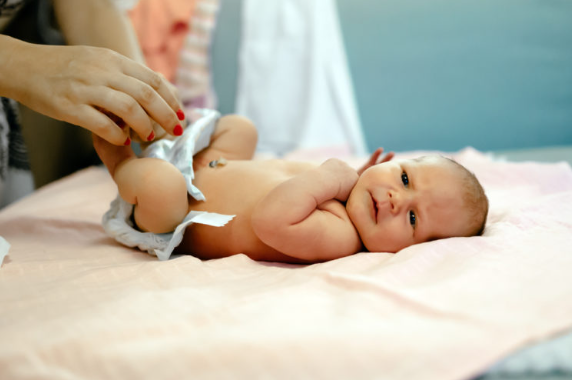
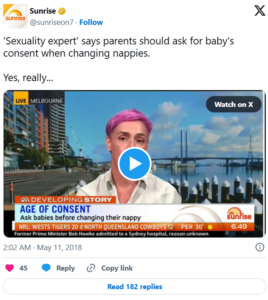
An Australian “sexuality educator” has sparked heated debate online after suggesting that parents ask a baby for permission before changing their diapers.
Deanne Carson argues that a “culture of consent” should begin at birth, prompting curiosity and confusion across social media, with one user even asking whether it’s also necessary to get “consent from your cat to change its litter tray.”
In a world where parenting approaches are evolving faster than ever, the topic of consent is reaching unexpected areas—including diaper changes.
Asking a baby for consent before changing a dirty nappy may sound impractical, mainly because newborns and infants lack the verbal skills to respond.
But Carson says it’s less about receiving a formal answer and more about laying the groundwork for consent and respectful boundaries as early as possible.
According to Carson—who describes herself on Twitter as a “sexuality educator, speaker, and author”—a culture of consent needs to start at birth. She explains that the idea is to emphasize respect for a child’s body and autonomy. By narrating actions—such as, “I’m going to change your diaper now, is that okay?”—and pausing to observe body language, parents can introduce infants to the concept of personal agency.
Building trust and communication
The self-proclaimed expert says the practice isn’t about waiting for a verbal “yes,” but about encouraging a two-way communication path between parent and child.
“Of course, a baby is not going to respond, ‘yes mum, that is awesome, I’d love to have my nappy changed,’” Carson said in an interview with Australia’s ABC network. “But if you leave a space and wait for body language and wait to make eye contact, then you are letting that child know that their response matters.”
Pediatricians and early childhood experts often stress the importance of responding to a baby’s non-verbal cues—such as coos, giggles, or movements—as part of healthy communication. Incorporating consent into diaper changes aligns with this by helping babies become aware, on some level, of what is happening and involving them in the process.
‘Left lunacy’
However, not everyone views this approach as practical or necessary, and critics argue that infants are far too young to grasp the concept of consent.
Rowan Dean, editor of The Spectator Australia, called the idea of asking a baby’s permission to change their nappy “lefty lunacy.”
John Rosemond—a psychologist, columnist, and parenting expert—wrote that Carson deserves the title of “the Weird and Even Weirder for the Most Bizarre Idea of All Time.”
“Once upon a time, and not all that long ago, a person who proposed that parents should ask infants for consent to change their diapers would be regarded by everyone except herself as deranged,” Rosemond wrote in the Reno Gazette Journal. “In this paradoxical fashion, Carson’s ‘culture of consent’ becomes instead a family culture of confusion, mistrust, denial, and all-around dysfunction.”
Online, Carson’s remarks sparked a firestorm of discussion, with many social media users mocking her ideas and questioning her credentials.
“Pretty sure when a baby is crying due to the discomfort of a full diaper… that’s consent. In fact, I would go further and call it a demand,” one user wrote.
Another added, “A self-proclaimed ‘expert’ wants parents to ask permission before changing their child’s diaper. This tells me she has no experience with kids whatsoever.”
A third user responded to a clip shared on X, saying: “Do you need to get consent from your cat to change its litter tray? No. If it stinks, change it. Same with a baby. If it does wee or pooh, just change it!!!”
Another commented, “Leaving a child in a dirty nappy is legally recognized as child abuse. Does this nut job believe in child abuse? She is more dangerous than those advocating for no jabs.”
However, some people came to her defense, arguing that Carson’s intentions were good, even if her example was not.
One user wrote, “I’m seriously shocked at the negative response you got to this… babies [and] toddlers learn to communicate well before they can speak. Thank you for tolerating the trolls to create dialogue about this. Even if you’re wrong, what possible harm is there in showing respect?”
Another commented, “I think she wants to encourage a conversation about consent among kids but has made a mockery of it by taking it to the extreme. Babies can’t consent to anything. Ever. They’re babies! Their safety and survival needs are assumed.”
A third added, “I agree with Deanne Carson. Easy to chat to your baby. Easy to create a climate of consent in your home.”
While the debate continues, many agree there is value in being mindful and communicative with infants, even if it’s not strictly about consent.
Ultimately, the choice to “ask” for consent may come down to individual parenting styles and comfort levels. For some, asking for consent is simply another way to cultivate a respectful, loving relationship with their infants; for others, it may be enough to engage, observe, and respond to their baby’s needs.
What are your thoughts on Carson suggesting that parents ask babies for permission when it comes to dirty diapers? Let us know what you think, and then share this story so we can hear from others!