A centuries-old mystery buried in a Finnish hillside has just taken a surprising turn.
New analysis of ancient DNA has revealed that a medieval warrior, long believed to be female, may have been nonbinary, challenging traditional assumptions about gender in early European societies.
The study, published in the European Journal of Archaeology, reexamines a grave unearthed in 1968 in Suontaka Vesitorninmäki, southern Finland.
According to the journal, the burial site contained a sword — a symbol often associated with masculinity during that period — alongside jewelry and fragments of woolen clothing typically worn by women at the time.
For decades, archaeologists interpreted the site as the grave of a high-status woman warrior. But new genetic testing tells a more complex story.
A small sample of ancient DNA revealed that the individual likely had Klinefelter syndrome, a condition in which a person is born with an extra X chromosome (XXY), according to the National Health Service. Though anatomically male, people with Klinefelter syndrome often have traits that do not fit neatly into traditional male or female categories, such as low testosterone, breast development, and infertility.
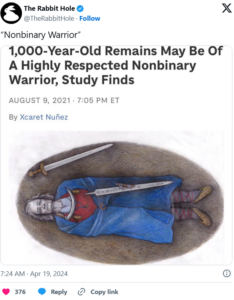
Lead researcher Ulla Moilanen, an archaeologist at the University of Turku, says the findings suggest that early medieval communities may have recognized and respected gender diversity.
“If the characteristics of Klinefelter syndrome were visible, this person might not have been considered strictly male or female,” Moilanen explains. “But the way they were buried, with both feminine and masculine items, shows they were accepted, even honored.”
Despite the remains being severely degraded, researchers used modeling and genetic analysis to conclude there was “overwhelming evidence” that the individual had an XXY chromosome pattern.
The grave itself supports this theory. It is unusually rich in both martial and decorative objects, suggesting the individual held a unique and respected social role.
Even more striking is the cultural context. Early medieval Scandinavia was known for rigid gender roles, particularly in the hyper-masculine world of warriors. Men who expressed femininity were often mocked or shamed. Yet this individual appears to have defied those norms while still commanding respect.
“It’s a powerful reminder that biology doesn’t dictate identity,” says Moilanen. “And that gender expression may have been more fluid, and more accepted, than we’ve assumed.”
Researchers acknowledge that using modern terms like “nonbinary” to describe historical individuals is complex. Identity is personal, and there is no way to know how this person viewed themselves. Moreover, many people with Klinefelter syndrome do not identify as nonbinary or intersex.
Still, the study is being hailed as an important contribution to conversations about gender and history.
“This is a well-researched and fascinating case,” said Leszek Gardela, a researcher at the National Museum of Denmark who was not involved in the study. “It shows that early medieval societies had a more nuanced understanding of gender than we might expect.”
In other words, gender diversity is not a modern invention. It has always existed, even if we are only now beginning to uncover the evidence.