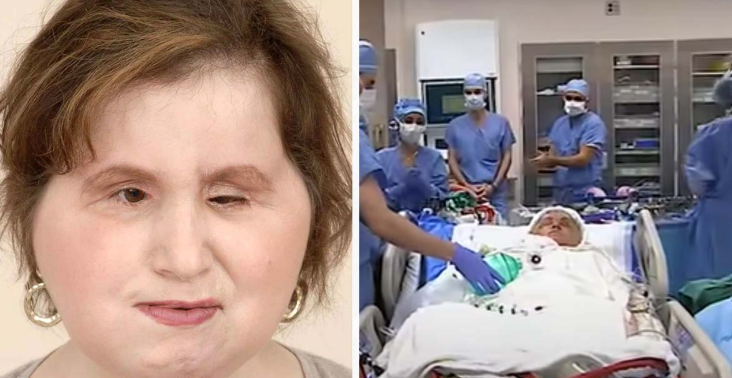
Katie Stubblefield had her whole life ahead of her, but everything changed after her boyfriend broke up with her at age 18. Tragically, the teenager shot herself — though by some miracle, she survived.
At 21, Katie became the youngest face‑transplant recipient in the United States and only the 40th person ever to undergo the surgery. It took more than 30 hours, but surgeons did an extraordinary job, giving the young woman a second chance at life. How Katie looks after the surgery is nothing short of incredible.
It’s easy to complain about the small things in our everyday lives. Maybe your morning coffee was a bit cold, the bus was running late, or the TV show you watched last night wasn’t as good as you hoped.
It’s normal to get frustrated — we all live different lives. But it’s also important to pause once in a while and appreciate what we have, even if we haven’t yet reached the dream scenario we’re striving for.
From now on, whenever I feel like I don’t have the energy to complete a small task — like doing the dishes or taking out the garbage — or feel like complaining about the little things, I’ve resolved to think of Katie Stubblefield.
Katie Stubblefield
At just 18, Katie tried to take her own life by shooting herself in the face. Miraculously, she survived, but lost her face — and ultimately underwent a face transplant.
This is her inspiring story, which we’d love for you to share with others.
Katie had everything going for her. Her family moved from Lakeland, Florida — where she had lived her whole life — to Owensboro, Kentucky during her sophomore year of high school. A year later, they moved again, this time to Oxford, Mississippi, where her parents began teaching at a local Christian school.
Katie was “fearless” and “a lot of fun,” her older sister Olivia recalled. She had a great sense of humor and always helped others. But as Katie grew older, Olivia noticed a change.
“She wanted to be the best in all of these sports she’d never even tried before,” Olivia said. “She wanted to be the best academically — she studied for hours, all the time.”
Chronic gastrointestinal troubles
Katie attended the school where her parents taught, and soon found love with a classmate. Their relationship was serious — they even discussed marriage.
But during her senior year, Katie’s life took a difficult turn. She had already dealt with chronic gastrointestinal issues and surgery. A year earlier, she had her appendix removed, which led to complications and the removal of her gallbladder.
On top of that, her parents had both been fired from their jobs at the school.
On March 25, 2014, shortly after turning 18, Katie found texts from another girl on her boyfriend’s phone. She confronted him, and he broke up with her.
Heartbroken, Katie felt she couldn’t go on. She drove to her brother’s house, visibly upset.
“I was like, ‘What are you doing home from school?’” Robert Stubblefield said. “So I called my parents, like, ‘Hey, just so you know, she’s at my house right now.’”
Tried taking her own life
Katie’s mother, Alesia, arrived to comfort her daughter, but Katie didn’t want to talk. Alesia and Robert stepped outside to discuss what had happened.
Suddenly, they heard what sounded like a door slamming. They ran inside to find the bathroom door locked.
“I tried to open the door,” Alesia recalled. “I said, ‘Katie?’ And nothing. And then I said, ‘Katie.’ And about the third time, my heart began to palpitate.”
“At that point, I smelled gunpowder,” Robert said. “And I knew exactly what had happened.”
Katie had shot herself in the face. Family and first responders feared the worst — that she was gone or beyond saving. But miraculously, she still had a pulse and could speak. She was rushed to the ER.
“When she was in that ER… she said, ‘Tell my mom and dad I love them. I’m sorry,’” her father told ABC. “It took a lot of strength.”
“I had no clue what a face transplant was”
Katie had lost parts of her forehead, nose, sinuses, and most of her mouth except the corners of her lips. The bones that formed her jaw and the front of her face were gone. Her eyes remained but were severely damaged.
Doctors weren’t sure she would survive, but they began reconstructing her face. That first night, they told her family that her best chance at a normal life was a face transplant.
“He said, ‘This is the worst wound I’ve ever seen, and the only thing that will give her any kind of life again is a face transplant,’” her father said.
Katie doesn’t remember the day she lost her face — or much of that year. Like her family, she was stunned to learn a face transplant was even possible.
“I had no clue what a face transplant was,” Katie said. “When my parents explained everything, I was very excited to get a face again and to have function again.”
“I felt so guilty”
Her parents had to tell her what happened, leaving Katie devastated.
“I never thought of doing that before, and hearing about it, I didn’t know how to handle it,” she said. “I felt so guilty that I had put my family through such pain.”
Katie was hospitalized in Oxford, Mississippi, then flown to Memphis, Tennessee. Her recovery would take time, and she was placed on a donor waiting list.
After a year, a donor was found. Adrea Schneider, 31, had passed away, and her family agreed to donate. Katie was transferred to Cleveland Clinic in Ohio for the transplant.
31‑hour surgery
On May 4, 2017, 11 surgeons and several specialists — with help from virtual reality — began the extensive procedure. It took 31 hours and was a major success.
“To reach this point of recovery has often been a difficult road, but I’m thankful there’s been a road — and Cleveland Clinic has been the vehicle to drive me along,” Katie said.
“I am forever grateful for the care this hospital has given me. And to my donor and her family — words cannot express my appreciation.”
Katie still had a long journey ahead. Her parents became her full‑time caregivers. She had a two‑and‑a‑half‑page list of daily medications.
She attended physical therapy twice a week, worked with a personal trainer twice a week, had occupational therapy once a week, braille lessons two or three times a week, and speech therapy four times a week.
Speaking was especially difficult. She now had the donor’s mouth, and only her upper tongue and soft palate remained. Her voice was strong and nasal — she described it as “like a frog.”
Still, Katie knew she was lucky to be alive.
Fourteen months after the transplant, doctors completed three major revision surgeries to slim her face, reduce scarring, and improve her eyelids.
“I am able to touch my face now, and it feels amazing,” Katie told CNN.
“You take it for granted — the bone, the tissue, the muscle — but when it’s gone, you recognize the need. And when you receive a transplant, you’re so thankful.”
Katie plans to attend college online and hopes to pursue counseling and motivational speaking — fitting for someone who turned her life around and now inspires people worldwide.
We are thrilled Katie received a second chance at life.
Please share this powerful story on Facebook to honor the incredible medical personnel who helped her — they are true heroes.